
Arrowhead type
Castroville Point
Castroville3,000 - 2,500 B.P.Late Paleo to Transitional Archaic22 reference photos
Key facts
- Age
- 3,000 - 2,500 B.P.
- Cultural period
- Late Paleo to Transitional Archaic
- Size
- Medium to Large
- Shape
- Basal Notch to Corner Notch
- Glacial period
- Neoglacial
Description
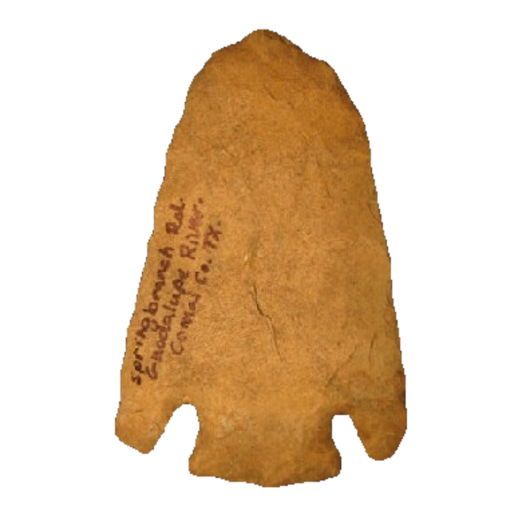
This triangular point exhibits a medium to large size, characterized by a basal notch that forms a distinctive barbed shoulder. The cross-sectional shape is typically flattened or elliptical, while the blade edge may display a range of curvature, from straight to excurvate. The notches, which originate from the base, create barbs that often extend to the base of the point, terminating in either a pointed or squared tip. Asymmetric barb formation is common, with one barb frequently longer or differently shaped than the other. However, on specimens that have undergone re-sharpening or reworking, the barbs may be reduced or entirely absent. The stem is generally broad, with a slight expansion, although some examples may have a nearly straight stem. The base of the point is usually straight, but can also be slightly convex. The flaking pattern on this point is random, lacking a consistent or organized arrangement.
Size
The arrowheads exhibit a range of dimensions, with overall lengths spanning 50 to 100 mm, and an average length of 70 mm. The stem length varies between 12 and 30 mm, generally accounting for approximately one-quarter to one-third of the total length. The width at the shoulders ranges from 30 to 60 mm, while the neck width is measured between 17 and 23 mm. Additionally, the basal width is recorded as falling within the range of 24 to 36 mm.
Distribution
These artifacts are mainly located on the Edwards Plateau of Texas and extending into the Pecos region. They can also be discovered eastwards into Anderson and Austin counties, albeit less often. This type can also be identified in southeastern New Mexico and northern Chihuahua, although at a lower rate
Mainly found in
Additional information
In the realm of Native American arrowhead typology, the Castroville point exhibits notable similarities with several other point styles, including the Marcos, Marshall, and Williams points. A key distinguishing feature of the Marcos point is the presence of a basal notch that enters at a more pronounced angle compared to the Castroville point. In contrast, the Marshall point tends to be more slender and is characterized by a distinctly narrower stem, setting it apart from the Castroville point. The Williams point, another related style, is recognizable by its barbs that do not extend all the way to the base. Interestingly, Castroville points that have been re-sharpened may adopt characteristics reminiscent of the Williams point, highlighting the complexities of point typology. Furthermore, the Castroville point also shares overlapping characteristics with the Lange point, underscoring the intricate relationships between these various point styles.
The similarities and differences between these point styles offer valuable insights into the technological and cultural practices of the Native American groups that created them. By examining the subtle variations in point morphology, archaeologists can gain a deeper understanding of the historical contexts and cultural exchange networks that shaped the development of these tools. The Castroville point, in particular, provides a fascinating case study in the evolution of point styles, with its unique combination of characteristics reflecting the dynamic interplay between functional necessity, cultural tradition, and technological innovation.
A closer examination of the Castroville point and its related styles reveals a complex landscape of technological and cultural exchange, with various point styles influencing one another over time. The presence of overlapping characteristics between the Castroville and Lange points, for example, suggests a degree of cultural continuity or exchange between the groups that produced these points. Similarly, the similarities between the Castroville and Williams points may indicate a shared technological heritage or a process of cultural diffusion. By carefully analyzing these point styles and their relationships, archaeologists can reconstruct a more nuanced and detailed picture of Native American cultural and technological development, highlighting the significance of the Castroville point and its related styles within the broader context of Native American archaeology.
Identified by
- Named by
- J. Charles Kelley
- Year
- 1947
- Type site
- Lehmann Rock Shelter, Texas
Similar types
Types that are easy to confuse with the Castroville point.
- Bella Vista
- Bulverde - Nopalera
- Calf Creek
- Lange
- Marcos
- Marshall
- Mehlville
- Nopalera
- San Jacinto
- Tepeapulco
- Williams
- Xihuingo
Other types in this cluster
- Kerrville Knife