
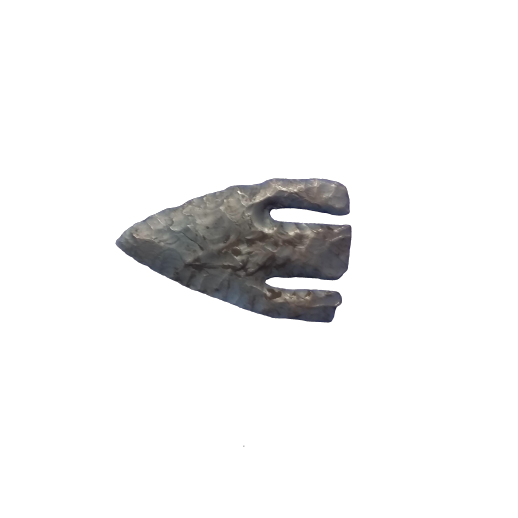
Arrowhead type
Andice Point
Andice6,050 - 5,050 B.P.Late Woodland19 reference photos
Key facts
- Age
- 6,050 - 5,050 B.P.
- Cultural period
- Late Woodland
- Size
- Medium to Large
- Shape
- Basal Notch
- Glacial period
- Middle Holocene
More from the Woodland period
Description
This triangular point exhibits a distinctive basal notch morphology, characterized by a medium to large size and an elliptical profile. The blade itself is marked by a broad, outwardly curved (excurvate) shape. Notably, the shoulders of the point are accentuated by pronounced barbs, with the narrowest segment of the barb occurring at the junction with the blade. The stem displays variability in its width, ranging from a slight contraction to a subtle expansion. The base of the point is typically concave, although it may occasionally present as straight. The flaking pattern observed on this point is random, lacking a discernible, organized arrangement.
Size
The dimensions of the arrowheads are as follows: they range in overall length from 40 to 80 mm. The stem, which comprises approximately one-third of the total point length, measures between 11 and 27 mm. The width of the blade spans 35 to 55 mm, while the stem width is between 14 and 20 mm, although it is noted that the latter measurement is based on a limited sample size.
Distribution
This projectile is mainly located in the Texas Gulf Coast area and extends into the central part of the state. It can also be discovered less often in the southern areas of Oklahoma.
Additional information
In the realm of Native American arrowheads, a distinct type of point exhibits characteristics that set it apart from its counterparts, notably the Bell point. One of the primary distinguishing features of this point is its larger overall size, accompanied by a longer stem and barbs. A notable aspect of this type is the morphology of its stem, which tends to be straight or only slightly expanding, differing from the Bell type, where stems are more frequently slightly expanding. This observation is supported by research conducted by Turner and Hester in 1985, highlighting the importance of meticulous examination in identifying and categorizing these archaeological artifacts. By recognizing these subtle differences, archaeologists can gain a deeper understanding of the technological and cultural nuances of the societies that crafted these points, ultimately enriching our knowledge of Native American history and material culture.
Identified by
- Named by
- Elton R. Prewitt
- Year
- 1983
Similar types
Types that are easy to confuse with the Andice point.