
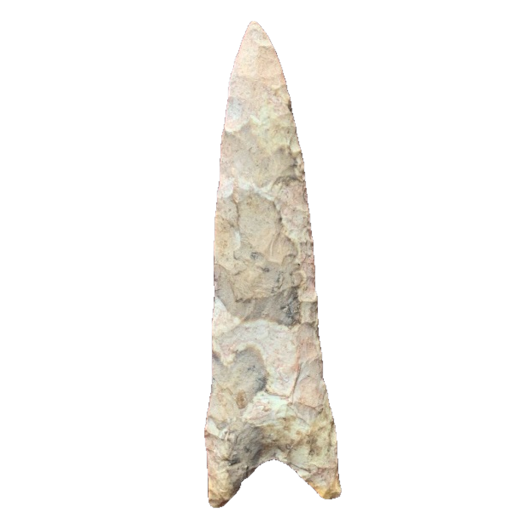
Arrowhead type
Sloan Point
SloanPlano Lanceolate Cluster10,000 - 8,500 B.P.Transitional Paleo19 reference photos
Key facts
- Age
- 10,000 - 8,500 B.P.
- Cultural period
- Transitional Paleo
- Size
- Small to Medium
- Shape
- Lanceolate
- Glacial period
- Early Holocene
More from the Paleo period
Description
The specimen exhibits a distinctive lanceolate morphology, characterized by an elliptical cross-sectional profile. The blade's curvature is predominantly excurvate, often accompanied by serrations along its edge. Notably, the shoulders are absent, giving way to a stem that subtly widens. The basal morphology varies, ranging from a slight concavity to a more pronounced, deep concave shape. Evidence of grinding is visible on the hafting area, with basal grinding and flaking being commonplace. In some instances, the basal flaking pattern may mimic the appearance of fluting. The flaking pattern itself is varied, oscillating between oblique transverse and random configurations.
In contrast, a smaller variant (measuring between 1.25 and 1.75 inches) presents a triangular form, with a stem that expands subtly and a cross-section that is flattened. The blade is generally straight, terminating in a sharp, well-defined tip. The stem is elongated and slightly expanding, while the base may exhibit a range of morphologies, from straight to mildly convex. The flaking pattern on this smaller point is characterized by a random, non-directional arrangement.
Size
The dimensions of the arrowheads are characterized by a total length ranging from 90 to 200 mm and a blade width spanning 30 to 60 mm.
Distribution
This specimen occurs within the central Mississippi River basin.
Additional information
Upon reevaluation, the classification of this particular point as a Dalton variant has been called into question. A closer examination of its physical characteristics reveals a stronger affinity with the Plano Lanceolate Custer type, rather than aligning with the characteristic traits of the Dalton cluster. This suggests that the initial labeling may not accurately reflect the point's true cultural and typological associations. Instead, it appears to embody the distinctive features of the Plano Lanceolate Custer, which may indicate a different cultural or chronological context than initially thought. As such, it is possible that this point does not represent a genuine variant of the Dalton type, but rather a distinct entity that warrants further consideration within the Plano Lanceolate Custer framework.
Identified by
- Named by
- Dan F. Morse
Similar types
Types that are easy to confuse with the Sloan point.