
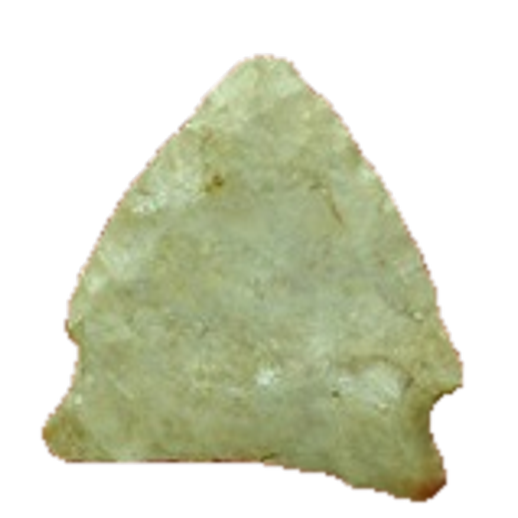
Arrowhead type
San Patrice Geneill Variety Point
San Patrice Geneill VarietySan Patrice Cluster10,000 - 8,000 B.P.Transitional Paleo to Early Archaic4 reference photos
Key facts
- Age
- 10,000 - 8,000 B.P.
- Cultural period
- Transitional Paleo to Early Archaic
- Size
- Small to Medium
- Shape
- Auriculate to Lanceolate to Side Notch
- Glacial period
- Early Holocene
Description
This auriculate point exhibits a slender profile, characterized by a compressed cross-sectional morphology. The blade's curvature can vary, ranging from a pronounced excurvate shape to a straight configuration. The shoulders display a range of orientations, from a horizontal alignment to an upward inclination. A distinctive feature of this point is its short, expanding stem, which terminates in a deeply concave base that forms prominent basal ears. The base has been thinned through the strategic removal of two or three channel flakes, which often extend upwards onto the point's face. Many specimens display evidence of basal grinding, suggesting a deliberate effort to refine the point's morphology. The flaking pattern on this point is characterized by a random arrangement of flakes, lacking a discernible pattern or orientation.
Size
The dimensions of these arrowheads are characterized by the following measurements: overall length ranges from 20 to 50 mm, with a mean length of 35 mm. The stem portion spans 5 to 10 mm in length. The blade itself exhibits a width of 20 to 35 mm, while the neck width varies between 12 and 28 mm. The basal width is generally comparable to the shoulder width, although it can be slightly narrower or wider. Fluting is present along 1/3 to 2/3 of the point's length. In terms of thickness, these arrowheads measure between 3.5 and 5 mm, with an average thickness of 4.5 mm.
Distribution
San Patrice points are predominantly clustered in the western Gulf Coast region (red) and gradually taper off in the eastern Gulf Coast area (yellow). These points are also found in central Texas, with notable occurrences of St. Johns, Hope, and Rodgers Side Hollow (Brazo Fishtail) varieties (green). According to Hurst et al. (2009), Hope and St. John's variants have been discovered at the Hardwick site in Roosevelt County, New Mexico, which falls within the green zone
Additional information
The arrowhead in question represents a rare and distinctive variant of the San Patrice point, a type of projectile point that holds significant interest for archaeologists. Characterized by its unique combination of stylistic and technological features, this particular point is noteworthy for its infrequent occurrence in the archaeological record. As such, it offers valuable insights into the diversity and complexity of prehistoric hunting practices, as well as the cultural exchange networks that existed among Native American communities.
The San Patrice point is typically associated with specific cultural and temporal contexts, although the exact dates and locations of its production and use are subject to ongoing research and refinement. Nonetheless, the study of such points contributes meaningfully to our understanding of the technological, social, and economic dynamics that shaped the lives of indigenous peoples in North America. By examining the morphological and metric characteristics of these artifacts, archaeologists can reconstruct aspects of the manufacturing process, functional use, and eventual discard or loss of these tools, thereby illuminating broader patterns of human behavior and cultural expression.
Further analysis of this rare San Patrice point variant may reveal additional details about the lives and traditions of the people who created and utilized it, potentially shedding new light on the intricacies of prehistoric cultural exchange, technological innovation, and adaptive strategies. As an important component of the archaeological record, this artifact merits continued study and consideration, offering a unique window into the experiences and achievements of Native American communities in the past.
Identified by
- Named by
- Jeffrey Brain
- Year
- 1983
Similar types
Types that are easy to confuse with the San Patrice Geneill Variety point.
- Dalton
- Kisatchie
- Palmer
- Pelican
- Rodgers Side Hollow
- San Patrice
- San Patrice Keithville
- San Patrice Hope
- San Patrice Leaf River
- San Patrice St. Johns
Other types in the San Patrice Cluster
- Albany
- San Patrice Kisatchie