
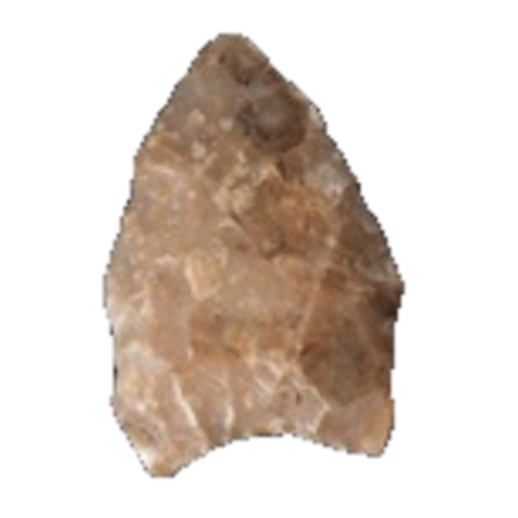
Arrowhead type
San Patrice Kisatchie Point
San Patrice KisatchieSan Patrice Cluster10,000 - 9,200 B.P.Transitional Paleo8 reference photos
Key facts
- Age
- 10,000 - 9,200 B.P.
- Cultural period
- Transitional Paleo
- Size
- Small to Medium
- Shape
- Auriculate to Side Notch
- Glacial period
- Early Holocene
More from the Paleo period
Description
This lanceolate point exhibits a distinctive auriculate form, characterized by an elliptical cross-section and a broad, short blade with a pronounced excurvate silhouette. The edge is often adorned with serrations, adding to its functional complexity. Shoulders, when present, are subdued and inclined upward, while the stem is notably short and subtly expanding. A concave base lends the point its signature auriculate appearance. Evidence of hafting region grinding and basal thinning is commonly observed, suggesting careful preparation for attachment. The flaking pattern on this point is random, with no discernible order or orientation, underscoring the artisan's emphasis on functional utility over formal symmetry.
Size
The dimensions of the arrowheads are characterized by a total length ranging from 25 to 60 mm and a basal width spanning between 20 and 35 mm.
Distribution
This type is mainly discovered in Louisiana and extends into easternmost Texas, Arkansas, and Oklahoma.
Additional information
In the realm of Native American archaeology, the San Patrice-Kisatchie arrowhead type holds significant importance, particularly in the context of the Early Archaic period. Initially defined by researchers Sherwood M. Gagliano and Hiram F. Gregory, this distinctive type was identified through the analysis of artifacts recovered from sites along Bayou Kisatchie, situated within the Kisatchie National Forest in Rapides Parish, Louisiana. Characterized by their medium size, typically ranging from 2 ½ to 3 inches in length, these projectiles and knives feature a unique combination of attributes, including short hafting areas and elongated side indentations that create ear-like protrusions at the base.
Notable characteristics of the San Patrice-Kisatchie type include the presence of ground stem sides and bases, as well as serrated blade edges, which suggest a high degree of craftsmanship and functional design. The geographic distribution of this type is believed to encompass Louisiana and Mississippi, highlighting the cultural exchange and technological diffusion that occurred among Native American groups during the Early Archaic period. As documented in the seminal work "A Preliminary Survey of Paleo-Indian Points from Louisiana" by Gagliano and Gregory (1965), published in Louisiana Studies (Vol. 4, No. 1, pp. 62-77), the San Patrice-Kisatchie type provides valuable insights into the lives and traditions of the region's indigenous populations.
It is worth noting that the nomenclature used to refer to this type can vary depending on the context, with professional archaeological sources typically employing the term "San Patrice-Kisatchie," while collector communities often use the alternative designation "Dalton Kisatchie." Despite these differences in terminology, the San Patrice-Kisatchie arrowhead type remains an essential component of our understanding of Native American material culture and technological development during the Early Archaic period, offering a fascinating glimpse into the lives and traditions of the region's ancient inhabitants.
Identified by
- Named by
- Sherwood M. Gagliano and Hiram "Pete" F. Gregory
- Year
- 1965
Similar types
Types that are easy to confuse with the San Patrice Kisatchie point.
- Dalton
- Dalton Breckenridge
- Meserve
- Pelican
- San Patrice
Other types in the San Patrice Cluster
- Albany
- San Patrice Geneill
- San Patrice Hope
- San Patrice Keithville
- San Patrice Leaf River
- San Patrice St Johns