
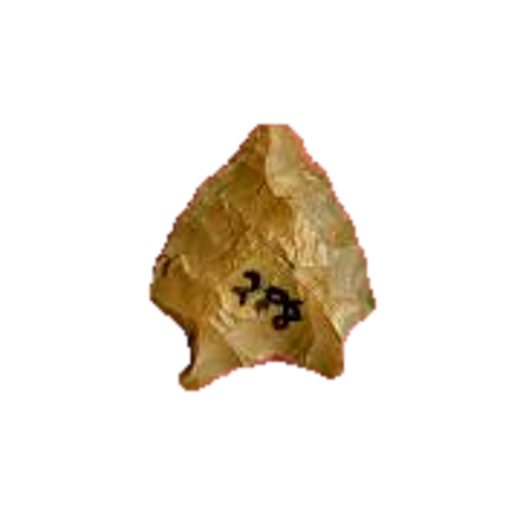
Arrowhead type
San Patrice St Johns Point
San Patrice St JohnsSan Patrice Cluster10,000 - 8,000 B.P.Transitional Paleo to Early Archaic10 reference photos
Key facts
- Age
- 10,000 - 8,000 B.P.
- Cultural period
- Transitional Paleo to Early Archaic
- Size
- Small to Medium
- Shape
- Triangle to Auriculate to Lanceolate to Corner Notch
- Glacial period
- Early Holocene
Description
This auriculate point exhibits a slender profile, characterized by a flattened cross-sectional morphology. The blade's curvature can vary, ranging from a subtle excurvate shape to a straight configuration, and may feature serrations along its edge. The shoulders of the point display a notable range of expression, from being barely perceptible to well-defined, and are positioned at an upward inclination. The notches are situated low on the blade, giving rise to a short, expanding stem. The base of the point is marked by a deep concavity, forming a distinctive auricle, which has been thinned through the removal of multiple channel flakes - typically two or three - that extend upwards towards the point's face. The flaking pattern observed on this point is random, lacking a discernible order or sequence.
Size
The dimensions of these arrowheads are characterized by a total length ranging from 20 to 65 mm, with an average measurement of 35 mm. The stem itself measures between 6 and 11 mm in length. In terms of width, the blade spans 20 to 35 mm, while the neck and basal widths are 15 to 25 mm and slightly narrower than the shoulders, respectively. The fluting extends along 1/3 to 2/3 of the point's length. The thickness of these arrowheads varies from 3 to 8 mm, with an average thickness of 5 mm.
Distribution
San Patrice points are predominantly clustered in the western Gulf Coastal Plains region (red) and gradually taper off into the eastern Gulf Coastal Plains area (yellow). San Patrice points are also documented in central Texas, with frequent occurrences of St. Johns, Hope, and Rodgers Side Hollow (Brazo Fishtail) varieties (green). Hurst et al. (2009) notes the presence of Hope and St. John's variants at the Hardwick site in Roosevelt County, New Mexico, which falls within the green zone
Additional information
More information needed.
Identified by
- Named by
- Clarence Webb
- Year
- 1943
Similar types
Types that are easy to confuse with the San Patrice St Johns point.
- Dalton
- Kisatchie
- Palmer
- Pelican
- Rodgers Side Hollow
- San Patrice
- San Patrice Geneill
- San Patrice Hope
- San Patrice Keithville
- San Patrice Leaf River
Other types in the San Patrice Cluster
- Albany
- San Patrice Kisatchie