
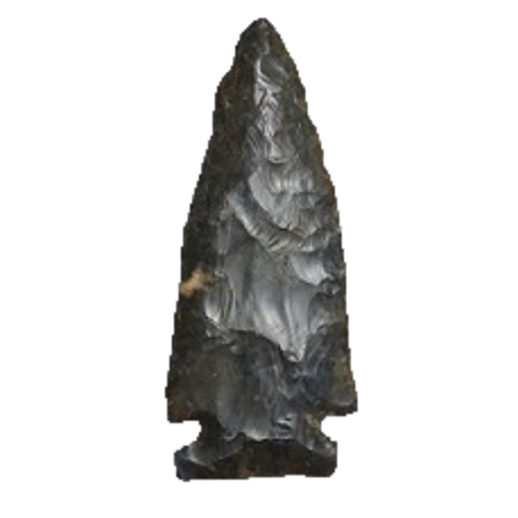
Arrowhead type
Raccoon Point
RaccoonJacks Reef Cluster1,500 - 1,000 B.P.WoodlandKey facts
- Age
- 1,500 - 1,000 B.P.
- Cultural period
- Woodland
- Culture
- Intrusive Mound Culture
- Size
- Medium
- Shape
- Side Notch
- Glacial period
- Roman to Medieval Warm
More from the Woodland period
Description
This medium-sized side notch point exhibits a distinctive triangular to pentagonal silhouette. Its cross-sectional profile is predominantly flat, although occasional specimens may display an elliptical shape. The blade's morphology varies from excurvate to angular, with the lateral edges typically running parallel to each other. Characteristic parallel notches create horizontal shoulders, defining the point's overall geometry. The stem is broadened, while the base is usually straight, sometimes featuring a subtle concavity. The presence of basal thinning and grinding is a common trait. The flaking pattern on this point is random, lacking a discernible order or sequence.
Size
The dimensions of the arrowheads are as follows: they typically range in overall length from 40 to 60 mm, with an average length of 49 mm. The stem of the arrowhead measures between 5 and 11 mm in length, averaging 9 mm. In terms of width, the blade spans 15 to 20 mm, with an average width of 18 mm, while the stem width ranges from 14 to 20 mm, averaging 17 mm. The thickness of the arrowhead varies from 3 to 6 mm.
Distribution
This type is mainly linked to the Intrusive Mound Culture of Ohio and the Ohio River valley. This type can also be discovered in western New York and Ontario
Mainly found in
Additional information
In the realm of Native American arrowheads, a specific type of point is often misidentified as a Jacks Reef Corner Notch. However, this particular point is distinct in its side-notched morphology and is actually associated with the Intrusive Mound culture, a post-Hopewellian cultural phenomenon. The Intrusive Mound culture, which emerged after the Hopewellian period, is characterized by a unique set of artifacts, including this side-notched point. Notably, another point type, also named Intrusive Mound, is linked to the same culture, but it exhibits a corner-notched configuration, differing from the side-notched variant in question.
The Intrusive Mound culture's archaeological record reveals a complex and fascinating narrative, with this side-notched point playing a significant role in understanding the cultural dynamics of the time. The presence of this point type provides valuable insights into the technological and stylistic developments of the Intrusive Mound people, highlighting their distinct cultural identity. Furthermore, the coexistence of both side-notched and corner-notched points within the same cultural context underscores the diversity and adaptability of the Intrusive Mound culture's lithic traditions.
The eventual decline of these point types is thought to have been accompanied by the emergence of the Levanna point, designated as W2, which ultimately replaced them. This transition marks an important milestone in the evolution of Native American arrowhead technology, reflecting the ongoing innovation and cultural exchange that characterized the region's prehistoric landscape. By examining the characteristics and associations of this side-notched point, researchers can gain a deeper understanding of the Intrusive Mound culture's place within the broader context of Native American archaeology, as well as the technological and cultural developments that defined this period.
Identified by
- Named by
- William J. Mayer-Oakes
- Year
- 1955
Similar types
Types that are easy to confuse with the Raccoon point.
Other types in the Jacks Reef Cluster
- Intrusive Mound
- Jacks Reef Corner Notch
- Knight Island