
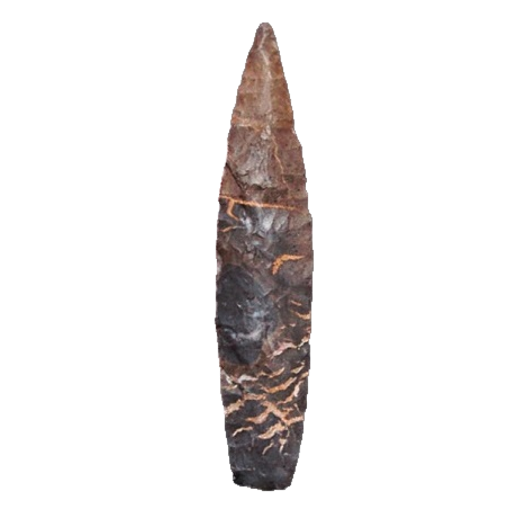
Arrowhead type
Packard Point
PackardPlano Lanceolate Cluster11,500 - 10,500 B.P.Transitional Paleo2 reference photos
Key facts
- Age
- 11,500 - 10,500 B.P.
- Cultural period
- Transitional Paleo
- Size
- Medium to Large
- Shape
- Lanceolate to Ovoid
- Material
- Agate
- Glacial period
- Late Pleistocene to Early Holocene
More from the Paleo period
Description
This lanceolate point exhibits a distinctive morphology, characterized by a median ridge that confers a diamond-shaped cross-sectional profile. Its slender blade tapers elegantly, with a pronounced excurvate shape that reaches its maximum width near the midpoint, occasionally slightly above it. The basal outline varies, ranging from a subtle concavity to a straight edge, accompanied by rounded corners that soften the overall contour. Notably, the hafting areas display intense basal grinding, indicative of deliberate shaping for attachment, yet lack any evidence of basal thinning. The flaking pattern is marked by a transverse parallel arrangement, where flakes converge and terminate neatly at the blade's midline, underscoring the point's carefully controlled manufacture.
Size
The dimensions of these arrowheads are characterized by a length range of 63 to 128 millimeters, a width spanning 22 to 32 millimeters, a basal width of 10 to 20 millimeters, and a thickness of 6 to 10 millimeters, as determined from a limited sample of Agate Basin points found in this region.
Distribution
This type is mainly discovered in northeastern Oklahoma and extends into the western Ozark Mountains and James River Valley of Missouri,
Additional information
The archaeological record reveals a distinct type of projectile point that bears a resemblance to the Agate Basin points, earning it the colloquialism "Eastern Agate Basin." Notwithstanding this similarity, a closer examination of these points reveals notable differences that set them apart from their Agate Basin counterparts. Specifically, the Eastern Agate Basin points exhibit a greater thickness, characterized by a pronounced median ridge that imparts a diamond-shaped cross-section. This morphological feature is a distinguishing characteristic that is not observed in the Agate Basin type, as highlighted by Emerson et al. in their 2012 study. The presence of this median ridge and resultant diamond-shaped cross-section underscores the unique attributes of the Eastern Agate Basin points, warranting further consideration of their cultural and technological significance within the context of Native American archaeology.
Identified by
- Named by
- Don Wyckoff
- Year
- 1984
- Type site
- Packard Site (34MY66), Mayes County, Oklahoma
Similar types
Types that are easy to confuse with the Packard point.