
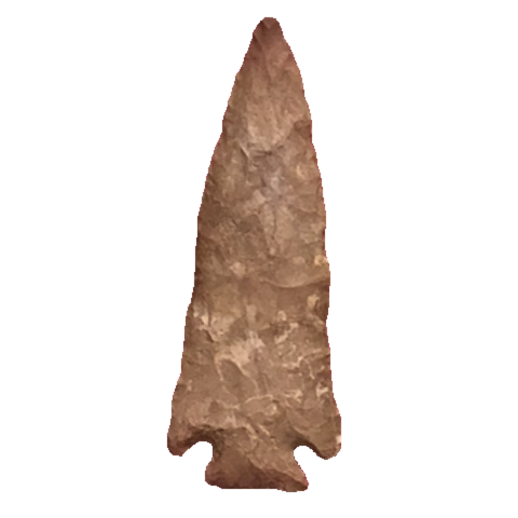
Arrowhead type
Kirk Corner Point
Kirk CornerKirk Corner Notch Cluster9,500 - 8,500 B.P.Early Archaic27 reference photos
Key facts
- Age
- 9,500 - 8,500 B.P.
- Cultural period
- Early Archaic
- Size
- Medium to Large
- Shape
- Corner Notch to Bifurcated
- Glacial period
- Early Holocene
More from the Archaic period
Description
This triangular corner-notched point exhibits a size range of 1.5 to 4 inches, characterized by a cross-sectional shape that transitions from flattened to elliptical. The blade profile is predominantly excurvate, although variations can occur, ranging from straight to recurvate. Serrations are often present, spanning a spectrum from fine to deep, and may be accompanied by beveling. The shoulders are distinguished by strong barbing, which can become less pronounced in specimens with heavily reworked blades. The stem expands in width, while the base displays variability, typically ranging from straight to concave, with convex bases being relatively rare. Notably, basal grinding is a scarce feature on this point type. The flaking pattern is random, lacking a discernible order or sequence.
Size
The dimensions of the arrowheads are as follows: they range in overall length from 32 to 120 mm, with a typical average length of 55 to 70 mm. The stem length varies between 9 and 15 mm, averaging 12 mm. The blade width spans 20 to 45 mm, with an average width of 29 to 34 mm. At the base, the stem width measures between 23 and 29 mm, averaging 25 mm. In terms of thickness, the arrowheads are 5 to 10 mm thick.
Distribution
This type is mainly linked to the Atlantic Coast area of the United States, extending into the Gulf Coast area and the Tennessee River and Ohio River valleys. This type is also located in the Mississippi River Valley and the Northeastern United States, but with less regularity
Additional information
The evolution of Native American arrowheads is a complex and fascinating topic, with various styles emerging over time. One such style, characterized by small corner-notched serrated points, has been dated to as late as 7,100 years before present (B.P.) in the northwest region, according to Michaels and Smith (1967) and Kraft (1975). However, some researchers, including Justice (2002), have expressed skepticism regarding the accuracy of these dates, suggesting they may be too recent.
The development of this particular point style is believed to have occurred following the Hardaway occupation, as noted by Coe (1959). During this period, there was a notable shift in projectile point design, with a greater emphasis on small, corner-notched, and serrated varieties featuring extensive basal grinding. This change was accompanied by an increase in the use of small, hafted, snub-nosed scrapers. Interestingly, Coe (1959) proposes that this point style may have evolved from the Palmer point, which is distinguished by its heavy basal grinding. In contrast, the small corner-notched serrated point is not typically characterized by significant basal grinding.
Notable regional variations have been observed in the size of these points, with average lengths differing between the Tennessee River Valley and the Seaboard region. For example, Coe recorded an average size of 70 mm in North Carolina, whereas Cambron found an average size of 55 mm in Alabama. Furthermore, John Whatley's research, as cited by Schroder (2013), suggests that the small Bolen Corner Notch point may be more accurately classified as a variant of this style, while the larger Bolen Corner Notch points may be more closely related to the Kirk Corner Notch style. These findings highlight the importance of considering regional and stylistic variations when analyzing and classifying Native American arrowheads.
Identified by
- Named by
- Joffre L. Coe
- Year
- 1964
- Type site
- Hardaway Site, Stanly County, North Carolina
Similar types
Types that are easy to confuse with the Kirk Corner point.
- Brewerton Corner Notch
- Crawford Creek
- Kings
- Lost Lake
- Nettling
- Neuberger
- Thebes
- Wells Bridge