
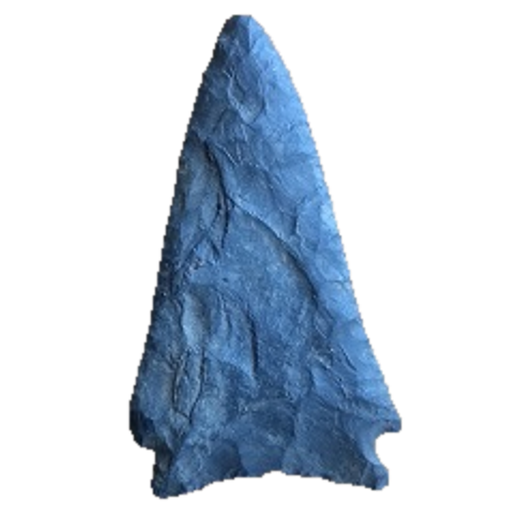
Arrowhead type
Angelico Point
AngelicoKirk Corner Notch Cluster9,500 - 8,000 B.P.Woodland3 reference photos
Key facts
- Age
- 9,500 - 8,000 B.P.
- Cultural period
- Woodland
- Size
- Medium
- Shape
- Corner Notch
- Glacial period
- Early to Middle Holocene
More from the Woodland period
Description
This triangular corner-notched point exhibits a slender profile, characterized by a medium thickness and a cross-sectional shape that transitions from elliptical to flattened. The blade's outline is predominantly straight, although it can display subtle variations, ranging from a slight excurvate to a slight incurvate curvature, particularly in re-sharpened specimens. The presence of beveling and serrations on the blade is a common feature, with a higher frequency observed in re-sharpened examples. The shoulder morphology varies, spanning from a slightly barbed configuration to a subtle upward inclination. The stem expands outward, terminating in a base that is slightly concave. Notably, this point type is often meticulously crafted, featuring a random flaking pattern that attests to the skill of its manufacturer.
Size
The dimensions of the arrowheads are as follows: they range in overall length from 35 to 60 mm, with stem lengths varying between 4 and 8 mm. The width of the blade spans 25 to 38 mm, while the stem width at its base measures between 17 and 30 mm, based on a limited dataset.
Distribution
This type is mainly discovered in the Piedmont area of Virginia, North Carolina, and extending into South Carolina, and also along the coastal areas of these states.
Mainly found in
Also found, less often, in
Additional information
The arrowhead points in question exhibit a striking resemblance to the Decatur points, which have been discovered in significant numbers within the Ohio River Valley and the Tennessee River Valley. According to the research conducted by Hranicky in 2011, it is hypothesized that this particular point type originated in southern Virginia, from where it subsequently migrated to the Ohio River Valley. Over time, this migration led to the evolution of the point type into what is now recognized as the Decatur type, highlighting the dynamic nature of cultural exchange and technological adaptation among Native American communities in the region.
Notably, the similarities between these points and the Decatur type underscore the complex patterns of migration, trade, and cultural diffusion that characterized the prehistoric landscape of eastern North America. The fact that these points were found in areas spanning the Ohio and Tennessee River Valleys suggests a high degree of mobility and interaction among indigenous groups, facilitating the spread of technological innovations and stylistic influences. The research by Hranicky provides valuable insights into the developmental trajectory of this point type, shedding light on the processes that shaped the material culture of Native American societies in the region.
The significance of the Decatur point type, and its antecedents in southern Virginia, lies in its ability to illuminate the intricacies of prehistoric cultural dynamics. By examining the distribution, morphology, and chronological placement of these points, archaeologists can reconstruct the pathways of technological transmission, cultural exchange, and migration that defined the lives of Native American communities in the region. As such, the study of these arrowhead points offers a unique window into the complex and nuanced history of human presence in eastern North America, highlighting the importance of continued research and analysis in this field.
Identified by
- Named by
- Floyd Painter
- Year
- 1964
Similar types
Types that are easy to confuse with the Angelico point.
Other types in the Kirk Corner Notch Cluster
- Amos
- Charleston Corner Notch
- Decatur
- Kirk Corner Notch
- Pine Tree Corner Notch
- Stilwell