
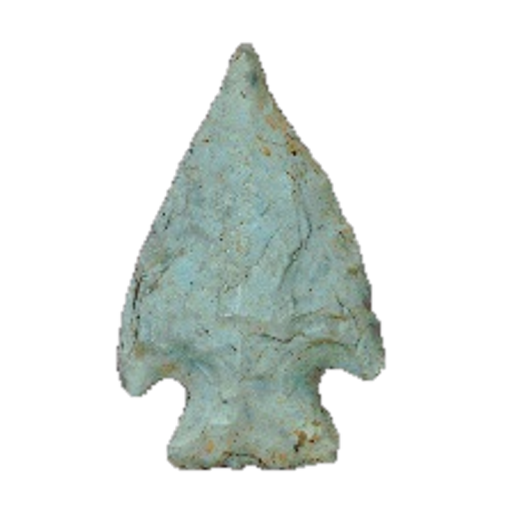
Arrowhead type
Barbee Point
BarbeeKirk Corner Notch Cluster9,500 - 8,500 B.P.Middle Archaic2 reference photos
Key facts
- Age
- 9,500 - 8,500 B.P.
- Cultural period
- Middle Archaic
- Size
- Medium
- Shape
- Corner Notch
- Glacial period
- Early Holocene
More from the Archaic period
Description
This triangular corner notch point exhibits a compact to medium size, characterized by an elliptical cross-sectional profile. The blade morphology ranges from excurvate to straight, particularly in re-sharpened specimens, which often display fine serrations. The shoulders are distinctly barbed, frequently extending nearly to the base, although re-sharpening can result in reduced barb expression. The stem expands outward, terminating in a base that is typically straight, but can vary subtly between slightly convex and concave contours. Notably, the hafting area often features pronounced basal grinding and thinning, yielding a smooth surface finish. The flaking pattern on this point is characterized by a random arrangement of flakes.
Size
Medium
Distribution
This type is mainly discovered in the Illinois Wabash Valley region.
Mainly found in
Additional information
In the realm of Native American arrowhead typology, a particular point of interest has been identified as a variant of the Kirk Corner Notch, as noted by Emerson et al. in their 2012 research. This distinctive arrowhead type bears a resemblance to the later Kings point, but a notable difference lies in the extent of basal grinding. Specifically, this variant is characterized by heavy basal grinding, which distinguishes it from the Kings point, where basal grinding is significantly lighter. This subtle yet significant difference highlights the importance of meticulous analysis in arrowhead classification, as even minor variations can provide valuable insights into the technological and cultural practices of ancient Native American communities.
The presence of heavy basal grinding on this arrowhead variant suggests a deliberate effort to shape and refine the base of the point, potentially for hafting or other functional purposes. In contrast, the lighter basal grinding observed on Kings points may indicate a different set of priorities or manufacturing techniques. By examining these variations, archaeologists can gain a deeper understanding of the complex and nuanced relationships between different arrowhead types and the cultural contexts in which they were produced.
Further study of this Kirk Corner Notch variant and its relationship to other arrowhead types, such as the Kings point, can provide valuable information on the evolution of Native American lithic technology and the cultural exchange networks that existed among prehistoric communities. By analyzing the technological and stylistic characteristics of these arrowheads, researchers can reconstruct a more detailed picture of the lives and traditions of ancient Native American peoples, shedding new light on the rich and diverse cultural heritage of North America.
Identified by
- Named by
- Howard D. Winters
- Year
- 1963
- Type site
- Multiple site in the Wabash Valley, Illinois
Similar types
Types that are easy to confuse with the Barbee point.
Other types in the Kirk Corner Notch Cluster
- Amos
- Angelico
- Charleston Corner Notch
- Decatur
- Kirk Corner Notch
- Pine Tree Corner Notch
- Stilwell