
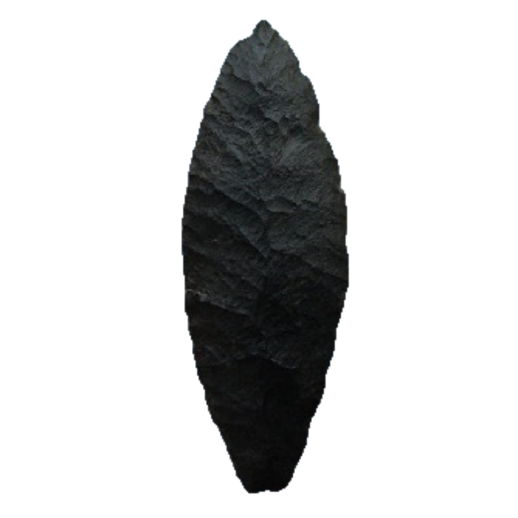
Arrowhead type
Humboldt Lanceolate Point
Humboldt LanceolateHumboldt Cluster7,000 - 3,000 B.P.Middle Archaic to Late Archaic29 reference photos
Key facts
- Age
- 7,000 - 3,000 B.P.
- Cultural period
- Middle Archaic to Late Archaic
- Size
- Small to Medium
- Shape
- Lanceolate
- Glacial period
- Middle Holocene to Neoglacial
More from the Archaic period
Description
This lanceolate point exhibits a slender profile, measuring between small to medium in size, with a cross-sectional shape that transitions from elliptical to flattened. Its blade displays a distinctive excurvate morphology, characterized by an inward curvature at the distal end, which gradually straightens to form parallel edges. The proximal end features a concave to notched base, often accompanied by evidence of basal thinning and grinding. The flaking pattern on this point typically presents an oblique transverse arrangement, although some specimens may exhibit a more random or irregular flaking pattern.
Size
The dimensions of these arrowheads are characterized by a total length ranging from 23 to 115 mm, with a typical average length of 35 to 45 mm. The maximum blade width varies between 11 and 55 mm. In terms of basal dimensions, the width is slightly narrower than that of the blade, while the basal concavity measures between 1 and 5 mm. The thickness of the arrowheads falls within a range of 4 to 7 mm.
Distribution
This style is prevalent across the Great Basin region and stretches into the Colorado Plateau area (red). Humboldt type points also reach into California's coastal areas, where they are referred to by names such as Mendocino Concave and Buchanan Eared (yellow)
Additional information
The emergence of Humboldt points on the Colorado Plateau is a notable phenomenon, marked by a relatively brief presence spanning approximately 7,300 to 6,800 years before present (B.P.), as documented by Berry and Berry (1986). A distinctive variant of these points, known as the Triple T, is characterized by its wider blade and concaved base, and is considered the oldest form of Humboldt point, according to Thomas (1983). Initially, researchers attempted to differentiate Humboldt points from McKean points based on their flaking patterns, with McKean points typically exhibiting collateral style flaking, whereas Humboldt points were thought to display oblique transverse style flaking. However, Hattori (1982) observed that Humboldt points can also exhibit random style flaking, which complicates this distinction.
A closer examination of the flaking patterns reveals that while oblique transverse flaking is a common characteristic of Humboldt points, it is not a universal trait. Instead, the flaking patterns on these points can be quite varied, making it challenging to rely solely on this feature for identification purposes. Despite these complexities, the study of Humboldt points remains significant, as they may have played a role in the subsequent development of the Fremont culture. It is possible that these points continued to be used, albeit in a modified form, as knives within this cultural context. This highlights the importance of considering the functional and technological adaptations of prehistoric cultures, as well as the potential for continuity and innovation in their material traditions.
The Triple T variant, with its distinctive morphology, offers valuable insights into the early stages of Humboldt point development. The wider blade and concaved base of this variant may have provided certain advantages in terms of functionality, such as enhanced cutting efficiency or improved grip security. As researchers continue to investigate the characteristics and distribution of Humboldt points, a more nuanced understanding of their role in the prehistoric record of the Colorado Plateau is emerging. By examining the technological, functional, and cultural aspects of these points, archaeologists can gain a deeper appreciation for the complexities and adaptations of the societies that created and used them.
Identified by
- Named by
- Robert F. Heizer and C. William Clewlow Jr.
- Year
- 1968
- Type site
- Lovelock Lake Bed Site, Humboldt Sink, Nevada
Similar types
Types that are easy to confuse with the Humboldt Lanceolate point.
- Allen
- Bat Cave
- Black Rock
- Fourth of July Lanceolate
- Green River
- Mendocino Concaved
- Meserve
- Pinto Shoulderless
- Plainview
- Tulare Lake
Other types in the Humboldt Cluster
- Buchanan Eared
- Humboldt Basal Notched
- Humboldt Constricting Base
- McKean
- Pinto Basin