
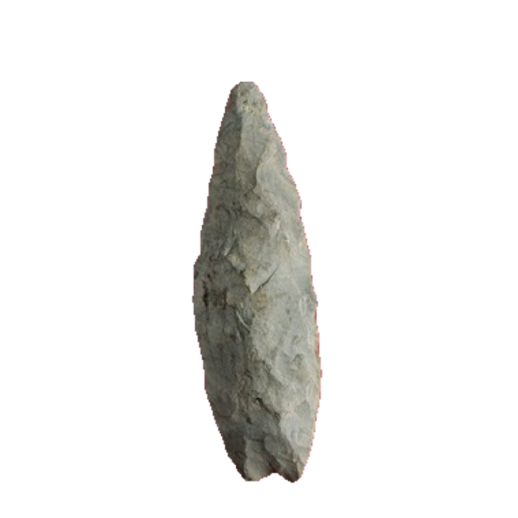
Arrowhead type
Guilford Concave Base Point
Guilford Concave Base6,200 - 5,000 B.P.Middle Archaic9 reference photos
Key facts
- Age
- 6,200 - 5,000 B.P.
- Cultural period
- Middle Archaic
- Size
- Medium
- Shape
- Lanceolate
- Glacial period
- Middle Holocene
More from the Archaic period
Description
This lanceolate point exhibits a substantial thickness, measuring between 1.9 and 4.75 inches. Its cross-sectional profile can range from an elliptical shape to one featuring a pronounced median ridge. The blade itself is characterized by an excurvate morphology, where the tip curves inward before recurving back towards the base, creating a distinctive silhouette. The basal edge is marked by a concave curvature. Notably, evidence of basal grinding is visible, indicating deliberate abrasion to smooth the base. The flaking pattern observed on this point is random, lacking a discernible or systematic arrangement of flake scars.
Size
The arrowheads exhibit a range of dimensions, with lengths spanning 40 to 120 mm, and averages typically falling between 65 to 95 mm. In terms of width, they measure between 15 to 35 mm, with most specimens averaging between 25 to 30 mm. Thickness varies from 5 to 12 mm, while the basal concavity ranges from 1 to 3 mm.
Distribution
These artifacts are mainly discovered in the Piedmont region of North Carolina and Virginia, extending into southern Maryland and up to northern Georgia. This type may also be located in the Tennessee River valley
Mainly found in
Also found, less often, in
Additional information
The Doerschuk site has yielded significant insights into the stratigraphic sequence of projectile points, with a particular layering pattern observed among certain point styles. Notably, the points in question were discovered in a stratigraphic position above those of the Morrow Mountain type, while being overlain by Halifax points, as documented by Coe in 1959. This distinct layering suggests a chronological progression, with the Doerschuk points likely preceding the Conerly points in the regional cultural sequence. The evolutionary relationship between these point styles is a subject of interest, with the Doerschuk points thought to have given rise to the Conerly points, implying a continuity of technological and cultural traditions among the region's prehistoric inhabitants.
The stratigraphic positioning of these points at the Doerschuk site provides a valuable framework for understanding the temporal dynamics of point styles in the region. By examining the superposition of these points, researchers can reconstruct a more nuanced picture of the cultural and technological developments that occurred over time. The observation that Doerschuk points are found below Halifax points, while being above Morrow Mountain points, underscores the importance of stratigraphic analysis in archaeological research, allowing for a more precise reconstruction of the cultural sequence and the evolution of point styles.
The evolutionary link between Doerschuk and Conerly points highlights the complex and dynamic nature of prehistoric cultural expression in the region. As archaeological research continues to refine our understanding of these point styles and their relationships, we gain a deeper appreciation for the ingenuity and adaptability of the region's indigenous populations, who developed and refined their technological traditions over time. By examining the material record of these cultures, we can reconstruct a richer narrative of human history, one that underscores the significance of the Doerschuk site as a key locus for understanding the cultural and technological developments of the region's prehistoric past.
Identified by
- Named by
- Joffre L. Coe
- Year
- 1964
- Type site
- Doerschuk and Gaston site, North Carolina
Similar types
Types that are easy to confuse with the Guilford Concave Base point.
- Angostura
- Clovis Un-fluted
- Haw River
- Wheeler Lanceolate