
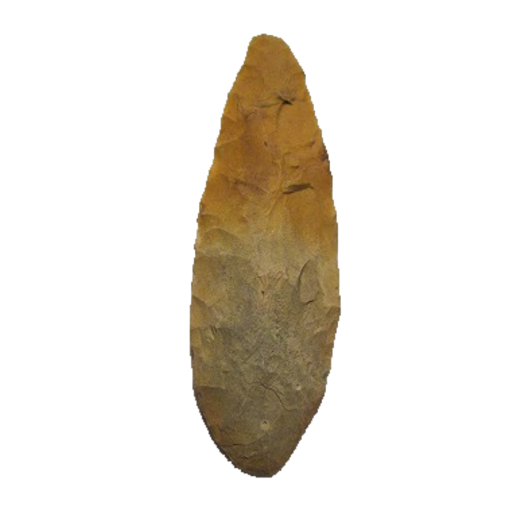
Arrowhead type
Guilford Round Base Point
Guilford Round Base6,200 - 5,000 B.P.Middle Archaic11 reference photos
Key facts
- Age
- 6,200 - 5,000 B.P.
- Cultural period
- Middle Archaic
- Size
- Medium
- Shape
- Ovoid
- Material
- Quartz
- Glacial period
- Middle Holocene
More from the Archaic period
Description
This lanceolate point exhibits a substantial thickness, measuring between 1.9 and 4.75 inches. Its cross-sectional profile can range from an elliptical shape to one featuring a pronounced median ridge. The blade itself is characterized by an excurvate morphology, where the tip curves inward before recurving back towards the base. The basal edge is marked by a convex curvature. Notably, evidence of basal grinding is visible, indicating deliberate abrasion of the base. The flaking pattern observed on this point is random, lacking a discernible order or orientation.
Size
Dimensional specifications for the arrowheads are as follows: they typically range in length from 40 to 120 mm, with a mean length generally falling between 65 and 95 mm. In terms of width, the measurements span from 15 to 35 mm, averaging between 25 and 30 mm. The thickness of these artifacts varies from 5 to 12 mm.
Distribution
These artifacts are mainly located in the Piedmont region of North Carolina and Virginia, extending into southern Maryland and up to northern Georgia. This type can also be discovered in the Tennessee River valley area
Mainly found in
Also found, less often, in
Additional information
The Doerschuk site has yielded a significant stratigraphic sequence, providing valuable insights into the chronology of Native American arrowhead types. Notably, the points in question were discovered in a distinct layering pattern, with the Morrow Mountain points situated beneath them and the Halifax points found above. This stratification, first documented by Coe in 1959, offers a fascinating glimpse into the technological and cultural evolution of the region's indigenous populations. By examining the relative positions of these point types, researchers can reconstruct a more nuanced understanding of the site's occupational history and the dynamics of cultural exchange and development over time.
The layered distribution of these arrowhead types at the Doerschuk site is particularly noteworthy, as it suggests a clear temporal progression from the Morrow Mountain points to the points in question, and ultimately to the Halifax points. This sequence not only sheds light on the site's internal chronology but also contributes to a broader understanding of the regional cultural landscape. The fact that these points were found in a specific stratigraphic order implies a degree of cultural continuity and technological innovation, highlighting the complex and dynamic nature of Native American cultural expression in the region.
The discovery of these points at the Doerschuk site, as reported by Coe in 1959, has significant implications for our understanding of the archaeological record in the region. By carefully examining the stratigraphic context and cultural associations of these artifacts, researchers can gain a deeper appreciation for the lives and traditions of the Native American communities that created them. The Doerschuk site, with its carefully documented sequence of arrowhead types, serves as a vital component in the ongoing effort to reconstruct the rich cultural heritage of the region's indigenous peoples.
Identified by
- Named by
- Joffre L. Coe
- Year
- 1964
- Type site
- Doerschuk and Gaston site, North Carolina
Similar types
Types that are easy to confuse with the Guilford Round Base point.
Other types in this cluster
- Guilford Straight Base
- Guilford Yuma
- Halifax
- Savannah River