
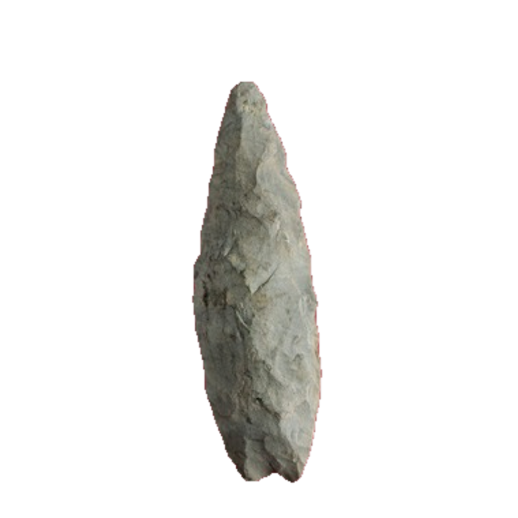
Arrowhead type
Guilford Straight Base Point
Guilford Straight Base6,200 - 5,000 B.P.Middle Archaic31 reference photos
Key facts
- Age
- 6,200 - 5,000 B.P.
- Cultural period
- Middle Archaic
- Size
- Medium
- Shape
- Lanceolate to Triangle
- Material
- Quartz
- Glacial period
- Middle Holocene
More from the Archaic period
Description
This lanceolate point exhibits a robust profile, measuring between 1.9 and 4.75 inches in thickness. Its cross-sectional shape can range from a smooth elliptical contour to one featuring a distinctive median ridge. The blade's curvature is excurvate, characterized by an inward tip deflection that recurves back towards the base. The basal edge remains straight, while evidence of intentional basal grinding is visible. The flaking pattern on this point appears to be random, lacking a discernible organizational structure.
Size
The dimensions of the arrowheads are characterized by a length range of 40 to 120 mm, with a mean length typically falling between 65 to 95 mm. In terms of width, the measurements span from 15 to 35 mm, with an average width generally ranging from 25 to 30 mm. The thickness of the arrowheads varies from 5 to 12 mm.
Distribution
These artifacts are mainly discovered in the Piedmont regions of North Carolina and Virginia, extending into southern Maryland and reaching up to northern Georgia. This type may also be located within the Tennessee River valley area
Mainly found in
Also found, less often, in
Additional information
The Guilford point variant, designated as W10, is a relatively rare archaeological find. Notably, excavations at the Doerschuk site have provided valuable insights into the stratigraphic context of these points. According to the research conducted by Coe in 1959, the Guilford points were discovered in a specific layer, situated above the Morrow Mountain points and below the Halifax points. This stratigraphic positioning suggests a distinct chronological sequence, offering a glimpse into the technological and cultural developments of the Native American groups that crafted these arrowheads. The rarity of the W10 variant, combined with its precise stratigraphic context, makes it a significant find for archaeologists seeking to reconstruct the history and cultural associations of these ancient artifacts.
Identified by
- Named by
- Joffre L. Coe
- Year
- 1964
- Type site
- Doerschuk and Gaston site, North Carolina
Similar types
Types that are easy to confuse with the Guilford Straight Base point.
Other types in this cluster
- Guilford Stemmed
- Guilford Round Base
- Guilford Yuma
- Halifax
- Savannah River