
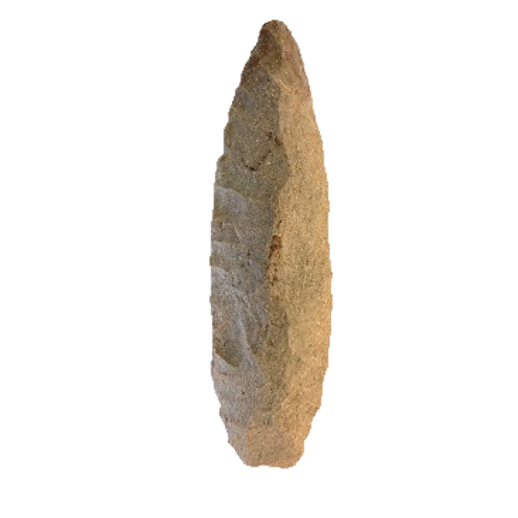
Arrowhead type
Guilford Stemmed Point
Guilford Stemmed6,200 - 5,000 B.P.Middle Archaic6 reference photos
Key facts
- Age
- 6,200 - 5,000 B.P.
- Cultural period
- Middle Archaic
- Size
- Medium
- Shape
- Contracting Stem to Expanding Stem
- Material
- Quartz
- Glacial period
- Middle Holocene
More from the Archaic period
Description
This stemmed lanceolate point exhibits a robust profile, with a thickness ranging from 1.9 to 4.75 inches. In cross-section, the point's shape can vary, presenting a rounded form, a distinct median ridge, or occasionally, an elliptical outline. The blade itself is characterized by an excurvate shape, curving outward from the point's center. The shoulders are either subtly defined or virtually absent, and when present, they slope upward. The stem's morphology can differ, being either straight or tapering inward. The base of the point is typically concave, although some specimens may display a straight base. Notably, the base exhibits evidence of basal grinding. The flaking pattern on this point is random, lacking a discernible order or orientation.
Size
The arrowheads exhibit a range of dimensions, with lengths spanning from 45 to 120 mm, and an average length of 90 mm. The stem length varies between 8 and 15 mm. In terms of width, the measurements fall within the 20 to 30 mm range. Additionally, the basal width and thickness of the arrowheads are recorded as 5 to 12 mm.
Distribution
These artifacts are mainly discovered in the Piedmont regions of North Carolina and Virginia, extending into southern Maryland and reaching as far as northern Georgia. This type may also be located within the Tennessee River valley area
Mainly found in
Also found, less often, in
Additional information
In the realm of Native American archaeology, the Briar Creek point holds significant importance, particularly in the context of its discovery and classification. The term "Briar Creek point" was coined by James L. Michie in 1968, marking a crucial milestone in the understanding of this archaeological artifact. Notably, the Briar Creek point bears a striking resemblance to the Guilford Stemmed point, as evident in the initial classification of the first specimen. Conversely, the second specimen was distinctly identified as a Briar Creek point, underscoring the nuances in classification within this category of arrowheads.
The stratigraphic context of the Briar Creek point is further illuminated by its discovery at the Doerschuk site, where it was found to occupy a specific position relative to other point types. According to the findings of Joffre Coe in 1959, the Briar Creek points were situated above the Morrow Mountain points and below the Halifax points, providing valuable insights into the chronological sequence of these artifacts. Moreover, the Briar Creek point is often referred to by an alternative name, the Conerly point, highlighting the complexities of nomenclature in archaeological research. The similarities in distribution, characteristics, and age between the Briar Creek and Conerly points have led researchers to suggest that they may, in fact, represent the same point type, with John Whatley proposing that these two points are likely coeval, implying a shared temporal context.
The coeval nature of the Briar Creek and Conerly points underscores the intricate relationships between different point types and their corresponding cultural associations. As archaeologists continue to refine their understanding of these artifacts, the Briar Creek point remains an essential component of the broader narrative of Native American archaeology, offering a unique window into the technological, cultural, and temporal dynamics of the region's indigenous populations. By examining the characteristics, distribution, and age of the Briar Creek point, researchers can gain a deeper appreciation for the complexities of Native American cultural expression and the significance of these artifacts in the archaeological record.
Identified by
- Named by
- Joffre L. Coe
- Year
- 1964
- Type site
- Doerschuk and Gaston site, North Carolina
Similar types
Types that are easy to confuse with the Guilford Stemmed point.
- Appalachian
- Conerly
- Savannah River Narrow Stem
- Stanly Narrow Stem
- Yadkin Eared
Other types in this cluster
- Guilford Straight Base
- Guilford Round Base
- Guilford Yuma
- Halifax
- Savannah River