
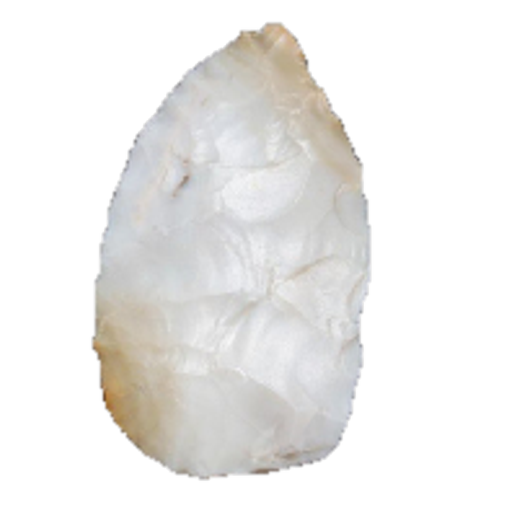
Arrowhead type
Granbury Point
Granbury1,300 - 700 B.P.Transitional Archaic2 reference photos
Key facts
- Age
- 1,300 - 700 B.P.
- Cultural period
- Transitional Archaic
- Size
- Medium
- Shape
- Ovoid
- Glacial period
- Roman Warm to Vandal Minimum
More from the Archaic period
Description
This diminutive point, measuring between 1.25 and 1.75 inches in length, exhibits a triangular form with a stemmed to expanding stem configuration. Its cross-sectional profile is characterized by a flattened shape. The blade itself is largely linear, terminating in a sharp, well-defined apex. The stem is elongated and subtly expands in width, while the basal edge varies from a straight alignment to a gently convex curvature. The flaking pattern observed on this point is random, lacking a discernible, organized arrangement.
Size
The dimensions of these arrowheads range from 20 to 40 mm in total length and 15 to 25 mm in width, based on a limited sample size and comparative analysis with similar Matamoros points.
Distribution
This type is mainly located from the Brazos River in the northwest to the Nueces River in the southwest. A corresponding boundary stretching southeast, 50 to 100 miles from the Balcones Escarpment, and extending north between Young and Edwards counties. The greatest densities are typically found in Young County, Texas
Mainly found in
Additional information
In the realm of Native American arrowheads, the Granbury point exhibits notable similarities to both the Matamoros and Catan points, yet it maintains distinct characteristics that set it apart. A key difference lies in the basal corners, where the Granbury point features rounded edges, whereas the Matamoros point is distinguished by squarer, more defined corners. This variation is significant, as it highlights the diversity within arrowhead typologies.
The Granbury point has been compared to the Fresno type by Jelks (1962), who observed similarities between the two. However, a closer examination reveals that the Granbury point is generally thicker, heavier, and cruder than its Fresno counterpart. This distinction is crucial in understanding the nuances of arrowhead classification. Furthermore, Jelks identified three distinct variations within the Granbury type, namely the Bono, Joshua, and Parker variations. Each of these variations exhibits unique characteristics, such as the sharp basal corners of the Granbury var. Bono, the rounded basal corners of the Granbury var. Joshua, and the narrower, longer convex base of the Granbury var. Parker. These variations demonstrate the complexity and richness of Native American arrowhead typologies, underscoring the importance of careful analysis and classification in archaeological research.
The study of arrowhead variations, such as the Granbury point and its associated types, provides valuable insights into the cultural and technological practices of Native American communities. By examining the characteristics of these artifacts, researchers can gain a deeper understanding of the historical contexts in which they were created and used. The Granbury point, with its distinct features and variations, serves as a significant example of the diversity and sophistication of Native American arrowhead craftsmanship, highlighting the need for continued research and analysis to uncover the stories behind these ancient artifacts.
Identified by
- Named by
- Edward B. Jelks
- Year
- 1962
- Type site
- The Kyle Site, Hill County, Texas
Similar types
Types that are easy to confuse with the Granbury point.