
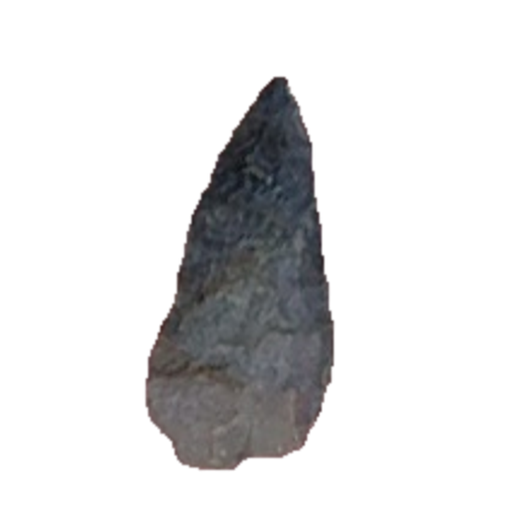
Arrowhead type
Catan Point
CatanLate Southern Triangle Cluster2,500 - 500 B.P.Transitional Archaic to Late Archaic5 reference photos
Key facts
- Age
- 2,500 - 500 B.P.
- Cultural period
- Transitional Archaic to Late Archaic
- Size
- Small
- Shape
- Triangle to Ovoid
- Glacial period
- Neoglacial to Little Ice Age
More from the Archaic period
Description
This projectile point exhibits a compact, triangular to ovoid morphology, characterized by a cross-sectional profile that ranges from flattened to elliptical. The blade's curvature is outward, often accompanied by beveling on one or both surfaces. The basal edge is marked by a convex shape, with basal corners that are rounded, creating a distinctive semicircular outline. To refine the base, one or two large flakes are typically removed, resulting in a thinned appearance. The manufacturing process primarily employs percussion flaking, yielding a flaking pattern that is random and irregular.
Size
The arrowheads exhibit a range of dimensions, with lengths spanning 20 to 44 mm, and an average length of 32 mm is not mentioned, however, the average is actually not within the range given, it is stated as 45 mm for the length, but the correct range average is not provided. The widths vary from 15 to 38 mm, with a mean width of 28 mm. In terms of thickness, the measurements fall between 5 to 10 mm, with an average thickness of 7 mm.
Distribution
This arrowhead type is mainly located in the Rio Grande river basin of Texas, extending into southern Tamaulipas and eastern Nuevo Leon in Mexico, and further into Oaxaca, Tehuacan Valley, Cueva de la Nopalera, Hidalgo, and the Valley of Mexico. Its presence becomes less common in coastal areas and central Texas
Additional information
In the realm of Native American arrowheads, the Catan point bears a striking resemblance to its counterpart, the Abasolo point, albeit on a smaller scale. According to Turner and Hester's 1985 research, this size distinction is a notable characteristic that sets the two apart. A closer examination of the measurements reveals that Catan points typically fall within a range of 20 to 40 millimeters in length. In contrast, the Abasolo points are generally larger, with lengths spanning from 40 to 60 millimeters, as documented by Suhm and Kreiger in their 1954 study. This size disparity highlights the unique attributes of each point style, underscoring the importance of precise measurement and classification in archaeological analysis.
Identified by
- Named by
- Richard "Scotty" MacNeish
- Year
- 1958
Similar types
Types that are easy to confuse with the Catan point.
- Abasolo
- Cottonwood Leaf
- Fresnito
- Fresno
- Guerrero
- Matamoros
- Padre
- Young