
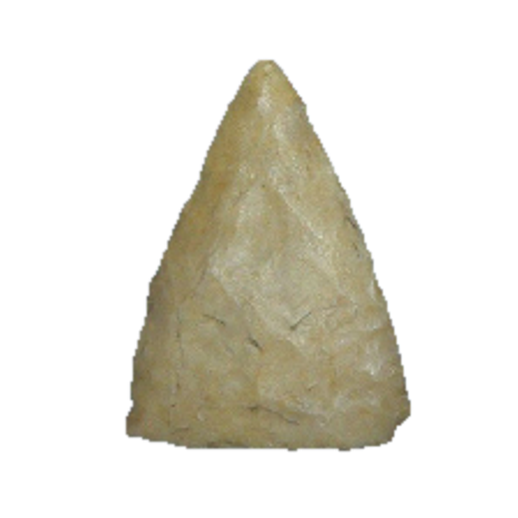
Arrowhead type
Matamoros Point
MatamorosLate Southern Triangle Cluster1,400 - 200 B.P.Transitional Archaic to Developmental9 reference photos
Key facts
- Age
- 1,400 - 200 B.P.
- Cultural period
- Transitional Archaic to Developmental
- Size
- Small
- Shape
- Triangle
- Material
- Pottery
- Glacial period
- Vandal Minimum to Little Ice Age
More from the Archaic, Developmental periods
Description
This triangular point exhibits a compact, sturdy form with a distinctive elliptical profile. Its straight-edged blade may occasionally exhibit a subtle curvature, giving it an excurvate appearance. The edges of the blade often display beveling, which can occur on either one or both sides in an alternating pattern. The base of the point can vary in shape, ranging from a gentle convexity to a slight concavity. A notable characteristic of this point is the presence of basal thinning, which suggests a deliberate attempt to reduce its thickness. The manufacturing process involved percussion flaking as the primary technique, supplemented by pressure flaking to refine the shape and create a random, irregular flaking pattern that is visible on its surface.
Size
The dimensions of these arrowheads are characterized by a total length ranging from 20 to 44 mm, with a mean length of 37 mm. The width varies between 15 and 27 mm, averaging 23 mm. In terms of thickness, the measurements span from 4 to 10 mm, with an average thickness of 7 mm, as documented by Suhm and Krieger (1954) and MacNeish (1967).
Distribution
This arrowhead is mainly discovered in the Trans Pecos area, spanning the Rio Grande River basin and extending into the Gulf Coast areas of Texas and Tamaulipas. This type has been identified in Tehuacan Valley, Mexico, and the Valley of Mexico. Occurrence of this arrowhead dwindles in central Texas and south of the Rio Grande Valley into Mexico. Bell (1958) situates this type in Oklahoma.
Mainly found in
Additional information
In the realm of Native American arrowheads, the Matamoros point exhibits a notable similarity to its larger counterpart, the Tortugas point. A key distinguishing feature between the two lies in their size, with Matamoros points typically ranging from 20 to 40 millimeters in length, whereas Tortugas points span from 40 to 80 millimeters. It is worth noting that the classification of these points can sometimes be nuanced, as exceptionally large Matamoros points with widths exceeding the normal range may be categorized as Tortugas, while smaller Tortugas points with narrower widths may be classified as Matamoros, as observed by Suhm and Krieger in their 1954 study.
The Matamoros point is frequently discovered in conjunction with Catan type points, suggesting a cultural or temporal association between the two. Interestingly, these points are relatively more recent than their larger counterparts, the Tortugas and Abasolo points. A significant aspect of Matamoros and Catan points is their co-occurrence with pottery, a characteristic that sets them apart from Tortugas and Abasolo points, which are not typically found in association with ceramic artifacts. This distinction, also highlighted by Suhm and Krieger in 1954, underscores the importance of considering the broader archaeological context in which these points are found.
The Matamoros point's characteristics and associations offer valuable insights into the lives and technologies of the Native American groups that crafted them. By examining the size, shape, and cultural context of these points, archaeologists can reconstruct aspects of the material culture and traditions of these communities. The presence of pottery alongside Matamoros and Catan points, for instance, may indicate a level of societal complexity or cultural exchange that is not evident in the contexts where Tortugas and Abasolo points are found. As such, continued study of these arrowhead types and their associations can contribute significantly to our understanding of Native American cultures and their historical development.
Identified by
- Named by
- Richard "Scotty" MacNeish
- Year
- 1954
- Type site
- Southern Tamaulipas, Mexico
Similar types
Types that are easy to confuse with the Matamoros point.