
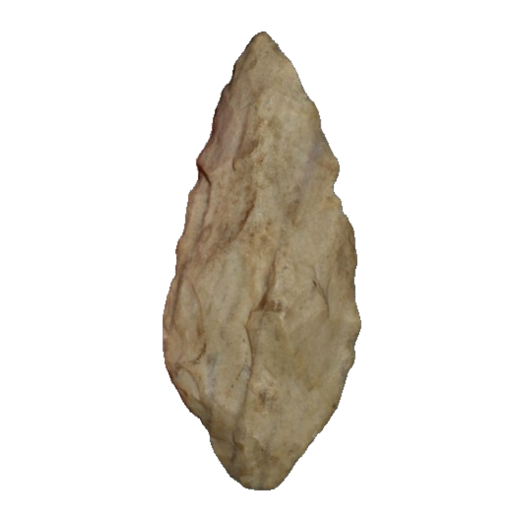
Arrowhead type
Goose Lake Knife
Goose Lake Knife2,500 - 2,000 B.P.Middle WoodlandKey facts
- Age
- 2,500 - 2,000 B.P.
- Cultural period
- Middle Woodland
- Shape
- Other
- Glacial period
- Neoglacial to Roman Warm
More from the Woodland period
Description
This triangular point exhibits a distinctive morphology, characterized by a medium to large size and a tapering stem. Its cross-sectional profile is elliptical, while the blade itself is notably broad and curved outward, displaying an excurvate shape. The shoulders of the point can be quite variable, ranging from pronounced and angular to subdued or even nonexistent, and are often positioned at an upward inclination. The stem, which contracts as it extends toward the base, terminates in a sharp, pointed tip. The flaking pattern observed on this point is random, lacking a discernible order or sequence.
Size
The arrowheads exhibit a range of dimensions, with overall lengths spanning 50 to 120 mm and blade widths varying from 30 to 45 mm.
Distribution
This tool is mainly discovered in the American Lowlands.
Additional information
The archaeological specimen in question bears a striking resemblance to the Peisker Diamond Knife, suggesting a possible evolutionary connection between the two. Notably, the characteristics of this knife appear to be an elaboration or refinement of the design principles underlying the Peisker Diamond Knife. This similarity implies a potential continuity in the technological and cultural developments that gave rise to these artifacts, warranting further investigation into their shared heritage and the historical context in which they were crafted.
A comparative analysis of the two knives could provide valuable insights into the innovations and adaptations that occurred over time, shedding light on the ingenuity and resourcefulness of the cultures that produced them. By examining the design elements, materials, and manufacturing techniques employed in each specimen, researchers can gain a deeper understanding of the technological and artistic traditions that defined these ancient societies. This, in turn, can inform our understanding of the broader cultural and historical landscape of the regions in which these artifacts were created.
The study of such artifacts is crucial for reconstructing the lives and traditions of past cultures, offering a tangible link to the people who crafted and utilized them. Through meticulous examination and comparison of these relics, archaeologists can reconstruct the narratives of technological evolution, cultural exchange, and artistic expression that defined the lives of ancient communities, ultimately enriching our appreciation for the complexity and diversity of human history.
Identified by
- Named by
- Thomas Emerson
- Year
- 1983
- Type site
- The Florence Street Site (11-5-458), American Bottoms. Illinois
Similar types
Types that are easy to confuse with the Goose Lake Knife point.