
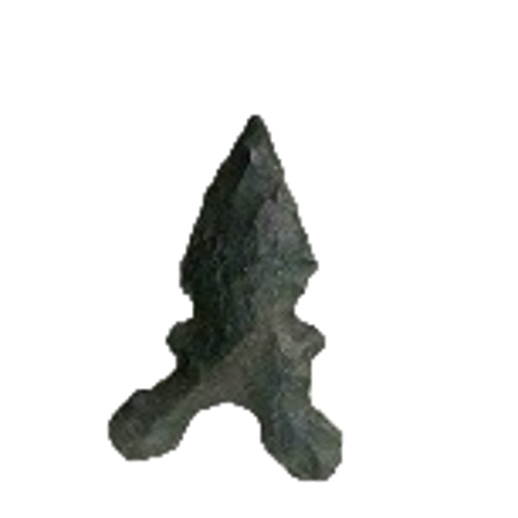
Arrowhead type
Buck Taylor Point
Buck TaylorPueblo Side Notch Cluster600 - 200 B.P.Historic3 reference photos
Key facts
- Age
- 600 - 200 B.P.
- Cultural period
- Historic
- Culture
- Yavapai Culture
- Size
- Small
- Shape
- Side Notch
- Material
- Obsidian
- Glacial period
- Classic to Historic
More from the Historic period
Description
This triangular side notch point exhibits a distinctive morphology, characterized by a cross-sectional profile that ranges from flattened to elliptical. The blade itself is largely straight, with a notable feature being the presence of multiple notches on both edges, which are typically symmetrical in arrangement. The notches can vary in number, but their distribution is consistently mirrored on both blades. A hallmark of this point is the presence of parallel, U-shaped notches that create horizontal shoulders and a broadened stem, which is formed through the convergence of these notches. The basal portion of the point is marked by a deep concavity, resulting in a V- or U-shaped configuration. The manufacturing process employed to create this point involved pressure flaking, yielding a random, non-patterned flaking arrangement.
Size
The dimensions of the arrowheads are as follows: they range in overall length from 21 to 35 mm, with stem lengths varying between 7 and 11 mm, averaging approximately 9 mm. The maximum width of these artifacts falls within the range of 14 to 18 mm, while their thickness measures between 2 and 4 mm, based on a limited sample size.
Distribution
This type is mainly discovered in northern and western Arizona, extending to the central areas. It is documented from the Grand Canyon area to the Flagstaff zone and onwards to the Phoenix Valley region
Mainly found in
Additional information
In the realm of archaeological research, the classification of Native American arrowheads is a complex and ongoing process. A notable example of this is the Red Horn point, initially introduced by avocational archaeologist Myers in a 1992 artifact newsletter. However, Myers' initial description lacked substantial data and details, rendering it insufficient as a definitive type. As a result, the name "Red Horn" never gained widespread acceptance within the professional archaeological community, and its usage was largely limited to a small circle of collectors.
It wasn't until Justice reexamined and redefined this point type that a clearer understanding and definition emerged, bolstered by robust supporting data. This redefinition has since led to the establishment of a new type, now recognized as the Buck Taylor type. The evolution of this point's classification underscores the importance of rigorous research and collaboration in the field of archaeology, where initial findings can serve as a foundation for future discoveries and refinements.
The Buck Taylor type, as it is now known, represents a significant addition to our understanding of Native American arrowhead typology. The fact that it was initially introduced under a different name, only to be later redefined and renamed, highlights the dynamic nature of archaeological research and the importance of ongoing evaluation and refinement. By examining the history and development of this point type, researchers can gain valuable insights into the complexities of archaeological classification and the contributions of both professional and avocational archaeologists to our collective knowledge of the past.
Identified by
- Named by
- Noel Justice
- Year
- 2002
Similar types
Types that are easy to confuse with the Buck Taylor point.
- Awatovi
- Desert
- Del Carmen
- Sobaipuri
- White Mountain
Other types in the Pueblo Side Notch Cluster
- Citrus Side Notch
- Gatlin
- Pueblo Side Notch
- Point of the Pines
- Ridge Ruin Side Notch
- Snaketown Side Notch
- Walnut Canyon
- Yavapai Side Notch