
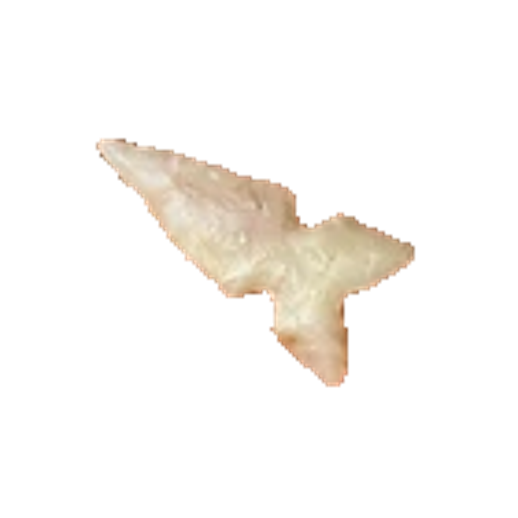
Arrowhead type
Toyah Point
Toyah600 - 300 B.P.Late Prehistoric to Historic16 reference photos
Key facts
- Age
- 600 - 300 B.P.
- Cultural period
- Late Prehistoric to Historic
- Culture
- Jumano Culture
- Size
- Small
- Shape
- Side Notch to Basal Notch
- Material
- Pottery
- Glacial period
- Little Ice Age
More from the Late Prehistoric, Historic periods
Description
This triangular point features a distinctive side notch configuration, characterized by a flattened profile and a straight-edged blade that may exhibit one or more notches situated above the shoulder area, extending up to halfway along the blade's length. The stem is broadened, while the base is marked by a concave curvature, often accompanied by a central basal notch. The basal ears are typically sharp and taper to a point. The overall flaking pattern on this point is random, lacking a discernible order or sequence.
Size
The arrowhead's dimensions are as follows: it measures between 15 and 25 mm in overall length. The stem, when measured to the top of the notches, ranges from 5 to 10 mm in length. The width of the blade spans 9 to 15 mm, while the neck width is between 5 and 8 mm. At its base, the width varies from 13 to 20 mm.
Distribution
This arrowhead is mainly located in the westernmost part of Texas, and the Mexican states of Chihuahua, Coahuila, and Tamaulipas. The prevalence of this type is higher in northern Mexico compared to Texas. It can also be discovered in the Rio Grande River Valley, although less often. It is seldom encountered in the central regions of Texas
Mainly found in
Additional information
In the realm of Native American arrowheads, a distinct point type has been identified, bearing similarities to the Harrell type, yet exhibiting notable differences in terms of size and morphology. This particular point is characterized by a smaller stature, as well as modifications to the blade and corners that are not typically observed in the Harrell type. Specifically, these modifications include notching, deep serrating, and in-cutting, as documented by Suhm and Krieger in 1954. The nomenclature associated with this point type has undergone various designations, with Kelley (1947) referring to it as the Saucia Split Base, Saragosa Notched Serrated, Frisco Base Notched, and Piedras Triple Notch, all of which were assigned to the Toyah Focus.
The classification of these points has been a subject of discussion, with Kelley's initial assignment to the Toyah Focus not being accompanied by a clear differentiation between the various types. Similarly, Suhm and Krieger (1954) opted to group these types together, rather than attempting to discern the distinctive characteristics of each. The designation "Toyah" was ultimately chosen due to its association with the Toyah Focus, as noted by Moore in 2015. Interestingly, Walter W. Taylor (1966) employed the term "Sierra Madre" to describe this point type, highlighting the complexity of nomenclature in this field.
From a chronological perspective, stratigraphic analysis at the Polvo site has provided valuable insights into the temporal relationships between the Toyah and Perdiz point types. As observed by Cloud et al. (1994), the Toyah type appears to slightly predate the Perdiz type, with the two coexisting for a period of time, and the Perdiz style persisting somewhat later than the Toyah. This information contributes to a deeper understanding of the cultural and technological developments of the Native American groups that crafted these arrowheads, underscoring the importance of continued research and analysis in this field.
Identified by
- Named by
- Dee Ann Suhm
- Year
- 1954
Similar types
Types that are easy to confuse with the Toyah point.