
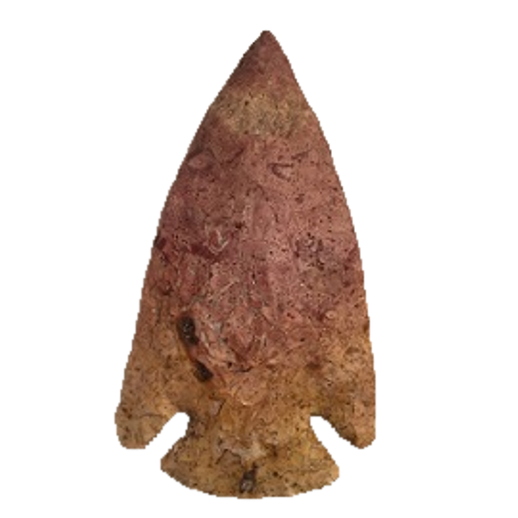
Arrowhead type
En Medio Point
En MedioSan Pedro Cluster2,800 - 1,600 B.P.Late Archaic to Transitional Archaic4 reference photos
Key facts
- Age
- 2,800 - 1,600 B.P.
- Cultural period
- Late Archaic to Transitional Archaic
- Size
- Medium
- Shape
- Corner Notch to Side Notch
- Glacial period
- Neoglacial to Roman Warm
More from the Archaic period
Description
This artifact exhibits a slender, triangular form with a corner-notch configuration, characterized by an elliptical profile. The blade itself is notably wide and outwardly curved, displaying an excurvate shape. The notches are situated at the corner of the preform, giving rise to a barbed shoulder that merges with an expanding stem. The basal edge varies in shape, ranging from a straight line to a gently convex curve, with the basal corners consistently rounded. The flaking pattern observed on this point is random, lacking a discernible order or sequence.
Size
The dimensions of the arrowheads are as follows: they range in overall length from 19 to 42 mm, with a mean length of 26 mm. The stem measures between 4 and 11 mm in length. The blade width varies from 16 to 31 mm, averaging 22 mm. The neck width is between 8 and 16 mm, while the notch depth ranges from 3 to 5 mm. Additionally, the basal width spans from 9 to 14 mm, and the thickness of the arrowhead is between 4 and 8 mm.
Distribution
This designation refers to San Pedro points characterized by wide blades and pronounced corner notches linked to the Ancestral Puebloan tradition (red), A comparable variant tied to the Mogollon and Hohokam traditions known as Hueco is located farther north (yellow). The green signifies the remaining geographic range of the San Pedro point unrelated to these traditions
Mainly found in
Additional information
In the realm of Native American archaeology, a specific type of arrowhead has been identified and referred to by multiple names, including the En Medio point, the Basketmaker II point, and the Hueco point. Despite the varying nomenclature, these points are believed to represent a continuum of technological development, with subtle regional distinctions. Notably, the Hueco or Basketmaker II points are characterized by their wide, thin blades, accompanied by broad notches and a narrow neck. In contrast, points discovered at the same sites with slightly narrower blades are often classified as San Pedro points. According to Justice (2002), the stylistic attributes of these points may exhibit minor variations, yet the underlying technology remains consistent.
The En Medio designation was first employed by Cynthia Irwin-Williams to describe examples unearthed at the En Medio shelter in New Mexico. These findings have been linked to the Basketmaker II cultural complex. Interestingly, smaller arrowheads associated with the subsequent Basketmaker III period were categorized by Irwin-Williams as Trujillo points. This typological distinction highlights the nuanced evolution of arrowhead technology across different cultural phases. By examining the morphological characteristics and technological attributes of these points, researchers can gain valuable insights into the lives and traditions of the indigenous peoples who crafted them.
The study of these arrowheads offers a fascinating glimpse into the technological and cultural developments of Native American societies during the Basketmaker II and III periods. The presence of these points at various archaeological sites, including the En Medio shelter, underscores the importance of considering regional variations and cultural contexts when interpreting the archaeological record. By continuing to investigate and analyze these artifacts, archaeologists can refine our understanding of the complex social, economic, and technological dynamics that shaped the lives of Native American communities in the region.
Identified by
- Named by
- Cynthia Irwin-Williams
- Year
- 1976
- Type site
- En Medio Shelter, New Mexico
Similar types
Types that are easy to confuse with the En Medio point.
- Black Mesa
- Carlsbad
- Cienega
- Elko Corner Notch
- Empire
- Marcos
- Mount Albion
- Palmillas
- Patinadas
- Williams