
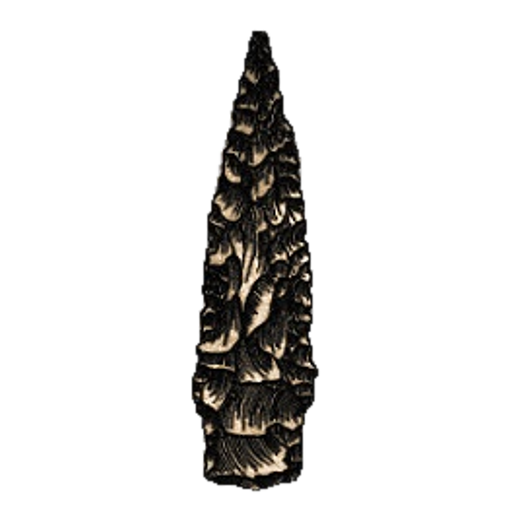
Arrowhead type
Empire Point
Empire3,200 - 2,000 B.P.Late Archaic to Transitional Archaic3 reference photos
Key facts
- Age
- 3,200 - 2,000 B.P.
- Cultural period
- Late Archaic to Transitional Archaic
- Size
- Medium
- Shape
- Straight Stem to Contracting Stem to Ovoid
- Material
- Obsidian
- Glacial period
- Neoglacial to Roman Warm
More from the Archaic period
Description
This triangular point features a distinctive elliptical to diamond-shaped profile, with a blade that exhibits a pronounced, narrow curvature and a serrated edge. The shoulders are either subtly defined or virtually nonexistent, sloping upward at a gentle angle. The stem, typically straight and only marginally narrower than the shoulder area, provides a stable platform for hafting. The base of the point varies in shape, ranging from a straight edge to a convex curve, and often displays crude, steep flaking or an unfinished appearance. Evidence of grinding is frequently observed in the hafting region, characterized by light, meticulous abrasion, sometimes accompanied by basal thinning. The overall flaking pattern appears random, with the point ultimately refined through the application of fine pressure flaking techniques.
Size
The arrowhead's dimensions are as follows: it has a total length of approximately 49 mm on average, with a stem that measures around 10 mm in length. The blade itself is 18 mm in width, tapering to a neck width of 15 mm, and a basal width of 16 mm. In terms of cross-sectional thickness, the arrowhead measures 7 mm in width.
Distribution
This projectile is mainly concentrated along the Gila River valley. Its presence becomes less common from the Gulf of California extending into central Arizona and southwestern New Mexico. This projectile has also been discovered at the La Playa site in Sonora and Costa Seri
Mainly found in
Additional information
In a comparative analysis of Native American arrowhead types, the Empire point exhibits notable similarities to the San Pedro point, yet distinct differences are evident in their morphological characteristics. A key distinguishing feature of the Empire point is its long, narrow blade, which is often accompanied by weak or absent shoulders. This configuration gives rise to a straight stem that is only marginally narrower than the blade itself. Furthermore, the Empire point's stem is characterized by a narrower width compared to the typical dimensions observed in San Pedro points. The length of both point types is remarkably similar, a factor that argues against the possibility that Empire points are simply re-worked San Pedro points, as suggested by Stevens and Sliva in their 2002 study. This similarity in length, combined with the other distinctive features, underscores the Empire point's unique position within the context of Native American arrowhead typology.
The Empire point's unique combination of characteristics, including its narrow blade and stem, sets it apart from other point types, such as the San Pedro. The absence or weakness of shoulders in Empire points is a notable feature that contributes to their distinctive morphology. The straight stem, which is only slightly narrower than the blade, is another characteristic that distinguishes Empire points from other types. The dimensions of the Empire point's stem, particularly its narrow width, are an important aspect of its overall morphology.
The study by Stevens and Sliva (2002) provides valuable insights into the relationship between Empire and San Pedro points, highlighting the importance of careful analysis and comparison in understanding the complexities of Native American arrowhead typology. By examining the morphological characteristics of these point types, researchers can gain a deeper understanding of the cultural and historical contexts in which they were created and used. The Empire point, with its unique combination of features, offers a fascinating example of the diversity and complexity of Native American arrowhead types, and its study continues to contribute to our knowledge of the region's rich cultural heritage.
Identified by
- Named by
- Michelle N. Stevens and R. Jane Sliva
- Year
- 2002
- Type site
- Multiple sites in the Cienega Valley and the Tucson Valley
Similar types
Types that are easy to confuse with the Empire point.