
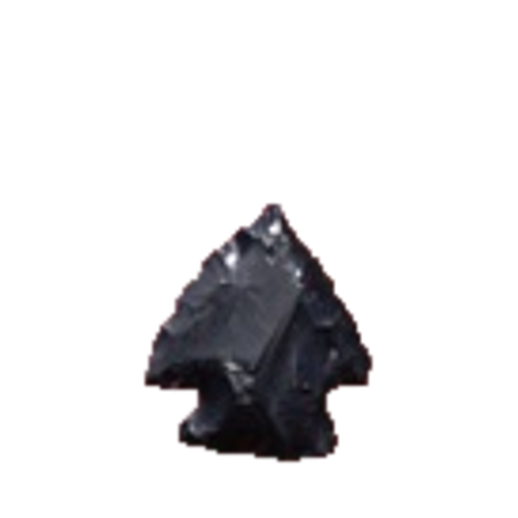
Arrowhead type
Trujillo Point
Trujillo1,550 - 1,140 B.P.Developmental2 reference photos
Key facts
- Age
- 1,550 - 1,140 B.P.
- Cultural period
- Developmental
- Culture
- Basketmaker III (Trujillo Phase)
- Size
- Small
- Shape
- Corner Notch
- Glacial period
- Roman Warm to Vandal Minimum
More from the Developmental period
Description
This triangular corner-notched projectile point exhibits a distinctive flattened profile. The blade's curvature can vary, spanning from a straight alignment to a pronounced excurvate shape. A broad notch emanates from the corner of the preform, giving rise to a shoulder that displays a range of barbing, from subtle to pronounced. The stem expands outward, terminating in a base that can be either straight or convexly curved. Characteristically, the manufacture of this point type is often coarse, with a flaking pattern that appears random and unstructured, lacking a deliberate or organized approach to flake removal.
Size
The dimensions of the arrowheads are as follows: they range in length from 14 to 26 millimeters, with a mean length of 21 millimeters. The width varies between 11 and 17 millimeters, averaging 14 millimeters. In terms of thickness, the measurements span from 2 to 6 millimeters, with a median thickness of 3 millimeters. Additionally, the neck width is measured between 4 and 10 millimeters, with a mean neck width of 7 millimeters, as reported by OLE in 1997.
Distribution
This type is mainly discovered in the Basketmaker III area of New Mexico and Colorado. This type may also be located in the adjacent territories of Utah and Arizona
Mainly found in
Additional information
In her 1971 study, Irwin-Williams examined a series of arrowheads from the En Medio Shelter in New Mexico, which she believed were smaller versions of the En Medio points, but did not formally establish a distinct type for these specimens. Later, OLE (1997) conducted a comparative analysis, noting that these points shared similarities with the Rosegate Corner Notch type, albeit with a notable distinction: the Trujillo type tends to exhibit a wider notch, typically exceeding 4mm in width, whereas Rosegate points usually have a narrower notch, measuring less than 4mm. This characteristic difference in notch width serves as a key diagnostic feature for distinguishing between these two point types.
The Trujillo points are notable for their broad characteristics, which led OLE (1997) to propose a more inclusive classification, encompassing all small, developmental points within this category. This approach acknowledges the complexity and variability of these arrowheads, which may have been produced during a transitional period in the development of projectile point technology. Interestingly, the use of small corner notch points, such as the Trujillo type, appears to have been phased out over time, with side notch points becoming more prevalent. According to OLE (1997), the corner notch points seem to have fallen out of use by around 1,000 A.D., marking a significant shift in the technological and cultural preferences of the region's indigenous populations.
The study of Trujillo points offers valuable insights into the evolution of projectile point technology and the cultural dynamics of the region's Native American communities. By examining the characteristics and distribution of these points, researchers can gain a better understanding of the technological, social, and economic factors that influenced the development of these artifacts. Furthermore, the comparison of Trujillo points with other types, such as the Rosegate Corner Notch, highlights the importance of nuanced classification and analysis in archaeology, allowing for a more detailed and accurate reconstruction of the past.
Identified by
- Year
- 1976
- Type site
- En Medio Shelter, New Mexico
Similar types
Types that are easy to confuse with the Trujillo point.
- Chaco
- Elko
- Hog Back
- Mummy Cave
- Rose Springs