
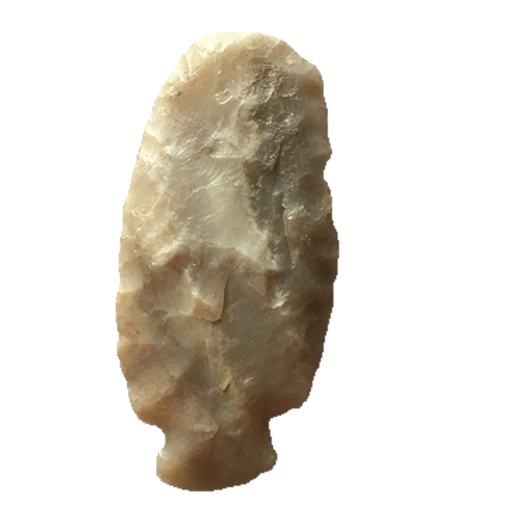
Arrowhead type
San Pedro Point
San PedroSan Pedro Cluster3,000 - 1,700 B.P.Late Archaic to Transitional Archaic14 reference photos
Key facts
- Age
- 3,000 - 1,700 B.P.
- Cultural period
- Late Archaic to Transitional Archaic
- Culture
- Cochise Culture
- Size
- Small to Medium
- Shape
- Expanding Stem to Corner Notch
- Glacial period
- Neoglacial to Roman Warm
More from the Archaic period
Description
This triangular point exhibits a medium to small size profile, characterized by a stem that expands outward from the blade. In cross-section, the point's shape can range from a flattened to an elliptical outline. The blade itself displays a varied curvature, oscillating between an excurvate and a straight profile. The shoulders of the point can present a subtle, upwardly inclined slope or a slightly barded appearance. Notably, the blade features wide, curving notches that originate from the corners, creating an expanding stem and imparting a distinctive corner-notch or expanding-stem morphology. These notches also form a broad neck, separating the blade from the base. The basal edge of the point is typically convex in shape, although it can occasionally appear straight. The absence of grinding on the basal and lateral edges of the hafting area is a characteristic feature of this point. The flaking pattern observed on this point is random, lacking a discernible, organized structure.
Size
The arrowheads exhibit the following dimensional characteristics: overall length ranges from 30 to 80 mm, with a typical span of 40 to 60 mm and a mean length of 47 mm. The stem portion measures between 7 and 18 mm in length, averaging 10 to 14 mm, with a mean stem length of 11 mm. The blade width varies from 15 to 35 mm, commonly falling within the 20 to 25 mm range, and has a mean width of 21 mm. The neck width spans 10 to 22 mm, typically averaging 12 to 15 mm, with a mean neck width of 14 mm. The basal width of the arrowheads is between 15 and 35 mm, with a mean basal width of 18 mm. In terms of thickness, the average measurement is 7 mm.
Distribution
This type is mainly located in the four corners area and across the southwest. These artifacts are discovered on the Uncompahgre Plateau of Colorado, the Rio Puerco of northwestern New Mexico and throughout much of Arizona. This type is discovered with less regularity into southern Arizona
Mainly found in
Additional information
In the realm of Native American archaeology, a specific type of arrowhead has been identified and referred to by multiple names, including the En Medio point, Basketmaker II point, and Hueco point. Despite the varying nomenclature, these points are believed to represent a continuum of technological development, with subtle regional distinctions. Characteristically, points classified as Hueco or Basketmaker II exhibit a wider, thinner blade with broad notches and a narrow neck, whereas those with slightly narrower blades found at the same sites are often categorized as San Pedro points. Notably, while stylistic attributes may exhibit minor variations, the underlying technology remains consistent, as observed by Justice in 2002.
The En Medio designation was first employed by Cynthia Irwin-Williams to describe examples unearthed at the En Medio shelter in New Mexico, which have also been linked to the Basketmaker II cultural complex. Interestingly, smaller arrowheads associated with the subsequent Basketmaker III period were classified as Trujillo points by Irwin-Williams, highlighting the nuanced technological and stylistic developments within these ancient cultures. The study of these arrowheads provides valuable insights into the technological and cultural trajectories of Native American groups, underscoring the importance of careful typological analysis and contextual consideration in archaeological research.
The examination of these arrowhead types not only sheds light on the technological sophistication of Native American cultures but also underscores the complexities of cultural classification and nomenclature. By recognizing the subtle variations and consistencies within these point types, researchers can gain a deeper understanding of the historical and cultural contexts in which they were crafted and utilized. Ultimately, the study of these artifacts contributes to a richer and more nuanced appreciation of the lives and traditions of Native American communities, highlighting the significance of continued archaeological inquiry and discovery.
Identified by
- Year
- 1965
- Type site
- Bat Cave, New Mexico
Similar types
Types that are easy to confuse with the San Pedro point.
Other types in the San Pedro Cluster
- En Medio
- Hueco