
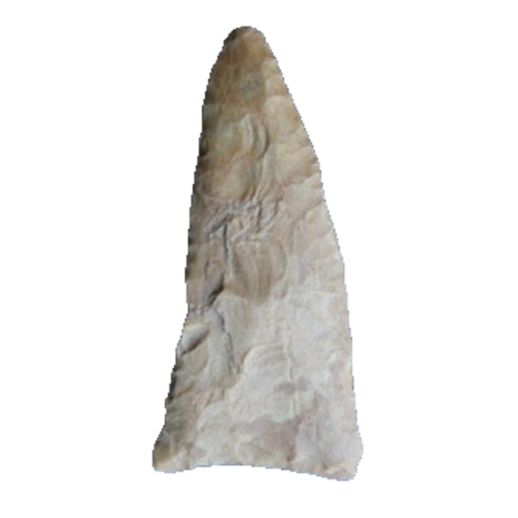
Arrowhead type
Copena Auriculated Point
Copena AuriculatedCopena Cluster4,000- 1,500 B.P.Late Archaic to Woodland4 reference photos
Key facts
- Age
- 4,000- 1,500 B.P.
- Cultural period
- Late Archaic to Woodland
- Culture
- Copper Burial Mound Culture
- Size
- Medium to Large
- Shape
- Auriculate to Lanceolate to Triangle
- Material
- Pottery
- Glacial period
- Neoglacial to Roman Warm
Description
This lanceolate point exhibits a distinctive auriculate form, characterized by a medium to large size and an elliptical cross-section that tapers to a central ridge. The blade itself displays a pronounced outward curvature, transitioning from a recurvate to an excurvate shape. Notably, the constriction in the hafting area contributes to the recurvate profile of the blade. The base of the point features a concave shape, with evidence of possible grinding or thinning. The flaking pattern observed on this point appears to be either random or collateral, suggesting a specific technological approach to its manufacture.
Size
The arrowheads exhibit a range of dimensions, with overall lengths spanning 45 to 130 mm, and an average length of 75 mm. The basal width of these artifacts falls within the range of 20 to 30 mm, while their thickness measures between 7 and 10 mm.
Distribution
This type is mainly located in the Tennessee River Valley. It can also be discovered in the Ohio River Valley, the central Mississippi River valley and the southeastern Coastal Plain region
Mainly found in
Also found, less often, in
Additional information
The Copena culture, predominantly found in northern Alabama, is distinguished by its notable use of copper and galena in burial artifacts, which ultimately led to the derivation of its name. A significant aspect of this culture's material record is the presence of arrowheads, or projectile points, that served multiple purposes. On one hand, these points were utilized for practical, everyday functions, reflecting the utilitarian needs of the Copena people. On the other hand, larger, more elaborate points were crafted for ceremonial use, highlighting the cultural and spiritual significance of these artifacts. As observed by Justice in 1987, the coexistence of these functional and ceremonial points within the Copena culture underscores the complexity and nuance of their technological and ritual practices.
The Copena culture's association with northern Alabama provides a geographic context for understanding the development and expression of their material culture, including the production and use of arrowheads. The incorporation of copper and galena in burial artifacts, alongside the variety of arrowhead forms and functions, demonstrates a sophisticated level of craftsmanship and cultural expression. The presence of both utilitarian and ceremonial points suggests a society with a strong spiritual foundation, where everyday life and ritual practices were deeply intertwined.
The study of Copena arrowheads, as discussed by Justice in 1987, offers valuable insights into the technological, social, and cultural dynamics of this ancient society. By examining the design, materials, and contexts in which these points were used, researchers can reconstruct aspects of Copena daily life, ritual practices, and cultural values. The analysis of these artifacts not only enhances our understanding of the Copena culture but also contributes to a broader appreciation of the diversity and complexity of Native American cultures in eastern North America.
Identified by
- Named by
- William Webb and David DeJannette
- Year
- 1942
- Type site
- Pickwick Basin, northern Alabama
Similar types
Types that are easy to confuse with the Copena Auriculated point.
- Beaver Lake
- Hazel
- Clovis Un-fluted
- Dalton
- Dalton Hardaway
- Quad
Other types in the Copena Cluster
- Copena Round Base
- Copena Triangular
- Copena Classic