
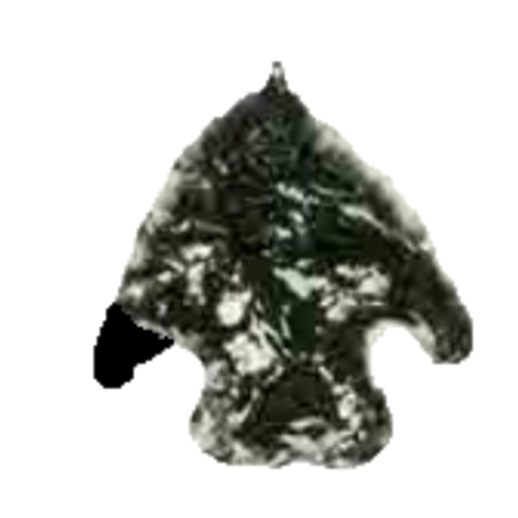
Arrowhead type
Belem Point
Belem2,500 - 1,500 B.P.Preclassic to early ClassicKey facts
- Age
- 2,500 - 1,500 B.P.
- Cultural period
- Preclassic to early Classic
- Size
- Medium
- Shape
- Basal Notch to Straight Stem to Expanding Stem
- Glacial period
- Culture:
More from the Preclassic and Classic period
Description
This triangular point exhibits a basal to corner notch configuration, characterized by a broad, medium-sized form with an elliptical profile. Its excurvate blade tapers to a slender, needle-like apex. The barbed shoulders display a distinctive, downward-sloping morphology, while the stem presents a variable outline, ranging from straight to expanding. The base of the point is notably straight. The manufacture of this point involved percussion flaking, supplemented by fine pressure flaking to refine and sharpen its edges, resulting in a random, irregular flaking pattern that covers its surface.
Size
The dimensions of the arrowheads are as follows: they range in length from 34 to 50 mm, with stem lengths varying between 11 and 19 mm. The width of the blade spans 22 to 27 mm, while the basal stem width measures between 16 and 23 mm. Additionally, the neck width falls within the range of 13 to 21 mm, and the notch width is between 7 and 13 mm. In terms of thickness, the arrowheads measure 5 to 9 mm, although it is noted that this measurement is based on a limited sample size.
Distribution
This specimen has been discovered at Cueva de la Nopalera, Hidalgo, Mexico. Such artifacts are believed to occur extensively across the Valley of Mexico
Additional information
More information needed.
Identified by
- Named by
- Angel Garcia Cook
- Year
- 1967
- Type site
- Cueva de la Nopalera, Hidalgo
Similar types
Types that are easy to confuse with the Belem point.
- Conejo
- Diablo Corner Notch
- Encino Type I
- Shumla