
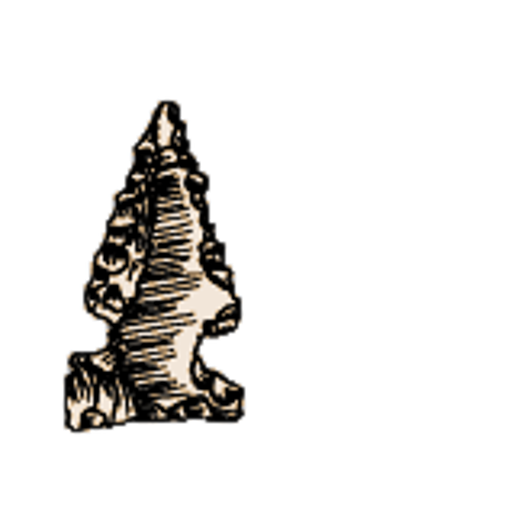
Arrowhead type
Comondu' Point
Comondu'1,000 - 300 B.P.Developmental to Historic4 reference photos
Key facts
- Age
- 1,000 - 300 B.P.
- Cultural period
- Developmental to Historic
- Culture
- Comondu' Culture
- Size
- Small to Medium
- Shape
- Side Notch to Bifurcated
- Glacial period
- Medieval Warm to Little Ice Age
More from the Developmental, Historic periods
Description
This side notch point measures between 0.5 and 3 inches in length, exhibiting a distinctive flattened cross-sectional profile. The blade itself is characterized by a slender width, with a shape that can vary from straight to gently curving outward, or excurvate. In some instances, the edge of the blade may feature uniform, square-shaped serrations, reminiscent of those found on points within the Stockton series. The shoulders of the point are marked by a sharp, square angle, while the base tapers outward at a consistent angle with the blade. Additionally, the lateral edges of the base may display notches, and the base itself can range from a straight to a concave shape. Overall, this point is notable for its thin, expertly crafted construction, featuring a uniform, randomly oriented flaking pattern that attests to the skill of its creator.
Size
The dimensions of the arrowheads are as follows: they range in overall length from 18 to 28 mm, exhibit a total width spanning 11 to 14 mm, and display a thickness that varies between 2 and 5 mm.
Distribution
This type is mainly discovered in regions linked to Ancestral Puebloan locales. This type may be discovered on the Colorado Plateau in the southern Manti La Sal range and southward to the Su Site of New Mexico and westward to Navajo Mountain.
Mainly found in
Additional information
In the realm of Southwestern archaeology, the Comondu' Triangular projectile point is a notable artifact, first identified by archaeologist Eric W. Ritter in association with the Comondu' Complex type sites in Baja California Sur, Mexico. Characterized by their narrow, well-crafted design, these points typically range in size from 0.50 to 3 inches and exhibit distinctive square serrations, bearing a striking resemblance to the Stockton and Snaketown types. The basal edges of these points can be either straight or concave, with simple side-notched forms occasionally found without serrations, although these are less common. Interestingly, the Comondu' points share a strong resemblance with certain Hohokam points discovered in north-central Arizona, albeit with a more rounded cross-section and significantly older age.
The Comondu' Triangular designation encompasses both unserrated and serrated types, with the latter corresponding to the Dos Cabezas Serrated type, as noted by Wilke and McDonald (1986), and potentially the Desert Side-notched type found in the United States. These points are also equivalent to the Cottonwood Triangular type in the western United States. The appearance of these points in the archaeological record marks the introduction of the bow and arrow in the region, with a timeline spanning from approximately A.D. 1000 to the historic period. Throughout central Baja California, Comondu' points are relatively abundant, highlighting their significance in the late prehistoric Comondú culture, as defined by Massey (1966b). Ritter (1979) was instrumental in establishing the designation of these points as Comondú points, which have been found in Baja California, southern California, and date back to the late Prehistoric period.
The Comondu' Triangular points offer valuable insights into the technological and cultural developments of the region during the late prehistoric period. Their widespread distribution and association with the Comondú culture underscore the importance of this artifact in understanding the dynamics of Southwestern archaeology. As a key marker of the bow and arrow's introduction, these points demonstrate the adaptability and innovation of the region's indigenous populations, highlighting the complexities of cultural exchange and technological diffusion in the Southwestern United States and northwestern Mexico.
Identified by
- Named by
- Eric W. Ritter
- Year
- 1979
Similar types
Types that are easy to confuse with the Comondu' point.