
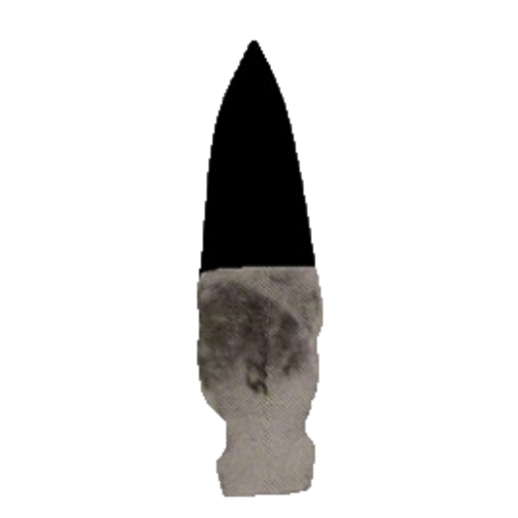
Arrowhead type
Durango Point
DurangoLate Southern Triangle Cluster1,450 - 650 B.P.Preclassic to Classic2 reference photos
Key facts
- Age
- 1,450 - 650 B.P.
- Cultural period
- Preclassic to Classic
- Culture
- Las Nieves and Guadiana cultures
- Size
- Small to Medium
- Shape
- Side Notch to Expanding Stem
- Glacial period
- Vandal to Medieval Warm
More from the Preclassic and Classic period
Description
This artifact exhibits a distinctive triangular form with a side notch configuration, characterized by an elliptical cross-sectional profile. The blade itself is slender and exhibits a pronounced excurvate shape, with the edges converging above the shoulder area to form a nearly parallel alignment before curving inward toward the apex. The notches, which are broad and shallow, intersect the preform's lateral margins, creating a shoulder that is relatively weak and inclined at an upward angle. The stem, which expands outward, is narrower than the shoulder and terminates in a straight base. The flaking pattern observed on this point is random in nature. Additionally, the point features a pentagonal stem with a cross-sectional profile that has been flattened.
Size
The dimensions of the arrowheads are characterized by a blade width ranging from 13 to 16 millimeters, with a mean width of 15 millimeters. The thickness of the arrowheads measures between 5 and 7 millimeters, with an average thickness of 6 millimeters. Note that these measurements are based on a limited sample size.
Distribution
This type has been documented from the Las Nieves complex to the later Guadiana localities of Durango and extending into southern Chihuahua
Mainly found in
Additional information
More information needed.
Identified by
- Named by
- Michael W. Spence
- Year
- 1971
Similar types
Types that are easy to confuse with the Durango point.
- Graceros Side Notch
- Rocker Side Notch
- San Pedro
- Sudden Side Notch
- Todsen