
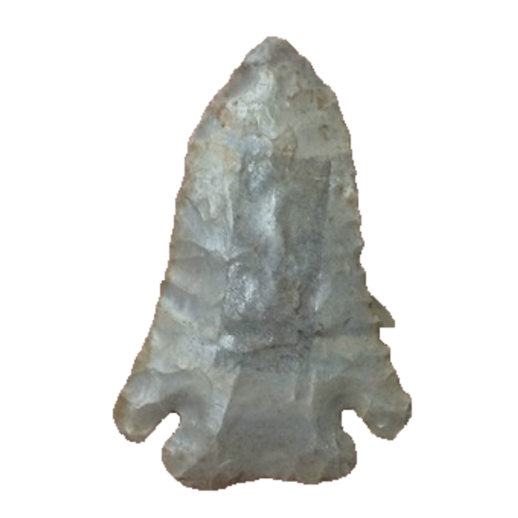
Arrowhead type
Charleston Point
CharlestonKirk Corner Notch Cluster9,500 - 8,000 B.P.Early Archaic7 reference photos
Key facts
- Age
- 9,500 - 8,000 B.P.
- Cultural period
- Early Archaic
- Size
- Medium to Large
- Shape
- Corner Notch to Bifurcated
- Glacial period
- Early Holocene
More from the Archaic period
Description
This triangular projectile point exhibits a distinctive median ridge in cross-section, with a size range spanning medium to large. The blade's curvature is predominantly outward and recurvate, often displaying asymmetry - a characteristic trait that aids in identification. The shoulders are typically pronounced and barbed, although heavy re-sharpening can result in slightly barbed or even straightened shoulders. The stem expands outward, while the base can vary in shape, ranging from convex to concave, and may feature basal thinning. Notably, the flaking pattern on this point is often characterized by parallel oblique flakes, although some specimens may exhibit a more random flaking arrangement, as observed by Justice in 2002.
Size
The dimensions of the arrowheads are as follows: they typically range in total length from 40 to 85 mm, with an average length of 45 to 55 mm. The stem measures between 9 and 13 mm in length. The blade width varies from 23 to 38 mm, averaging between 25 and 35 mm. The neck width is between 14 and 18 mm, while the stem width ranges from 17 to 30 mm. In terms of thickness, the arrowheads measure between 7 and 8 mm.
Distribution
This projectile is located from the central Mississippi River region eastward through the Ohio River valley to the eastern seaboard. This projectile is also located in the Tennessee River region.
Mainly found in
Also found, less often, in
Additional information
The distinction between the Charleston Corner Notched and Pine Tree Corner Notched arrowhead points has long been a subject of confusion among archaeologists and enthusiasts alike. This ambiguity stems, in part, from the physical similarities between the two points, as well as their overlapping geographic distributions. Furthermore, some identification guides have mistakenly conflated the two, suggesting that they represent a single point type with distinct northern and southern distributions. However, research has shown that these points are, in fact, distinct and separate entities. Notably, excavations at the St. Albans site and Ice House Bottom site have revealed that the Charleston Corner Notched point predates the Kirk Corner Notched point, with the former found in lower stratigraphic levels (Justice, 2002).
A closer examination of the characteristics and distributions of these points reveals several key differences. Firstly, while both points are found in southern regions, the Charleston Corner Notched point has a more easterly distribution, whereas the Pine Tree Corner Notched point is found further north. Secondly, the Charleston point tends to have a shorter and wider blade, often with a recurvate and asymmetrical shape (Justice, 2002). Additionally, the Charleston point frequently exhibits a median ridge, a feature less commonly observed in the Pine Tree point. In contrast, the Pine Tree point is considered a variant of the Kirk point, with a base consistent with the Kirk type, suggesting that it may have been re-sharpened from a Kirk point. This is analogous to the Palmer point, which also predates the Kirk point and often exhibits basal grinding, a feature more commonly associated with the Charleston point than the Pine Tree point (Broyle, 1971).
The clarification of these differences is crucial for accurate identification and interpretation of these arrowhead points. By recognizing the distinct characteristics and distributions of the Charleston Corner Notched and Pine Tree Corner Notched points, researchers can gain a more nuanced understanding of the cultural and temporal contexts in which they were produced and used. The Charleston point, with its more easterly distribution and distinctive blade shape, may provide insights into the technological and stylistic traditions of specific Native American groups, while the Pine Tree point, as a variant of the Kirk point, may reflect the re-sharpening and reuse of existing points, highlighting the resourcefulness and adaptability of these ancient cultures.
Identified by
- Named by
- Bettye J. Broyles
- Year
- 1971
- Type site
- St. Albans Site, Kanawha County, West Virginia
Similar types
Types that are easy to confuse with the Charleston point.
Other types in the Kirk Corner Notch Cluster
- Amos
- Decatur
- Kirk Corner Notch
- Palmer
- Pine Tree Corner Notch
- Stilwell