
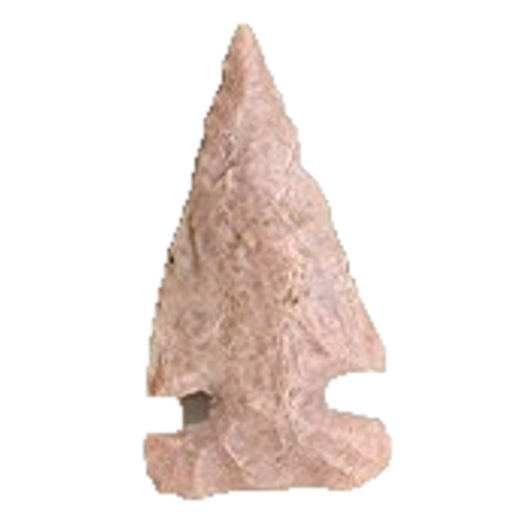
Arrowhead type
Caracara Point
Caracara600 - 400 B.P.Late Prehistoric3 reference photos
Key facts
- Age
- 600 - 400 B.P.
- Cultural period
- Late Prehistoric
- Size
- Small to Medium
- Shape
- Side Notch
- Glacial period
- Little Ice Age
More from the Late Prehistoric period
Description
This point exhibits a slender profile, measuring between small to medium in size, with a cross-sectional shape that ranges from elliptical to flattened. The blade itself is predominantly straight, occasionally featuring delicate serrations along its edge. Notable parallel notches are positioned near the base of the blade. The shoulders are characterized by a horizontal orientation, transitioning into an expanded stem. The basal ears are typically squared and sharply defined. The base of the point can vary, commonly presenting as straight or concave, although it may occasionally display a slight convex curvature. The flaking pattern observed on this point is random in nature, often showcasing high-quality flaking techniques.
Size
The dimensions of the arrowheads are as follows: they range in overall length from 24 to 53 mm, with stem lengths varying between 5 and 10 mm. The width of the blade spans from 13 to 25 mm, while the neck width measures between 7 and 14 mm. Additionally, the stem width is consistent with the blade, ranging from 13 to 25 mm.
Distribution
This type is mainly discovered in Mexico and extends into southern Texas. It is most frequently linked to the Falcon Lake area.
Additional information
More information needed.
Identified by
- Named by
- R. Saunders and Tomas Hester
- Year
- 1993
- Type site
- Falcon Lake sites
Similar types
Types that are easy to confuse with the Caracara point.
- Cache River
- Ensor
- Harrell
- Huffaker
- Knight Island
- Reed
- Rockwall
- Scallorn
- Washita