
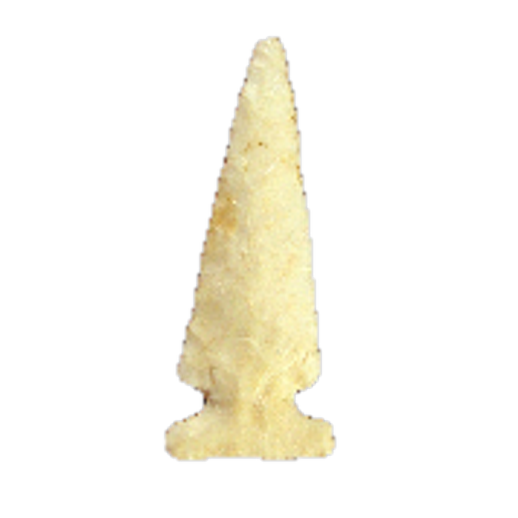
Arrowhead type
Reed Point
ReedCahokia Cluster1,500 - 500 B.P.Late Woodland to Mississippian18 reference photos
Key facts
- Age
- 1,500 - 500 B.P.
- Cultural period
- Late Woodland to Mississippian
- Size
- Small
- Shape
- Side Notch
- Glacial period
- Roman to Medieval Warm
More from the Woodland, Mississippian periods
Description
This triangular side notch point exhibits a slender profile, typically measuring between 0.75 and 1 inch in length, with an elliptical cross-sectional shape. The blade's curvature is predominantly excurvate, although some specimens may display a straight configuration. Notably, serrations are generally absent from this point type. Characteristic parallel notches are present, while the shoulder exhibits a range of orientations, from straight to a subtle, upward inclination. The stem expands outward, marked by a distinct angular transition from the blade. The basal edge varies in shape, ranging from straight to slightly convergent, and the base is typically straight, with some instances showing a slight concavity. The absence of basal grinding is a consistent feature of this point. The flaking pattern on this point is random, lacking a discernible, organized arrangement.
Size
The dimensions of the arrowheads are as follows: overall length ranges from 20 to 45 mm, while the stem length, measured to the top of the notch, spans 8 to 13 mm. The neck width is between 5 to 8 mm, and the basal width measures 10 to 15 mm.
Distribution
This projectile is mainly sourced from northern Texas and Arkansas, extending up to southern Minnesota. It is a prevalent style found throughout Iowa to Oklahoma.
Additional information
In the realm of Native American arrowheads, the Reed point is a notable type that bears resemblance to the Washita point, as observed by Bell in 1958. However, a distinctive characteristic of the Reed point is the pronounced change in angle from the blade to the stem, whereas the Washita point exhibits a more continuous angle from the tip to the base. Furthermore, the placement of parallel notches on the Reed point tends to be lower on the blade, in contrast to the Washita point, where these notches are typically situated higher up.
The Reed point also shares similarities with the triangular points found in the Woodland and Mississippian clusters, as noted by Morrow in 1984. A key difference, however, lies in the presence of side notches on the Reed point, which distinguishes it from other triangular points. These points are often characterized by their slender profile and triangular shape, frequently taking the form of an isosceles or equilateral triangle. Additionally, the blades of Reed points may feature single or multiple parallel notches, and in some cases, may be serrated, as seen in the W2 variant.
The distribution and cultural context of the Reed point are closely tied to the Mississippian culture and related complexes, with a primary concentration in the Mississippi River Valley. This geographic association highlights the significance of the Reed point within the broader context of Native American archaeology, underscoring the complex networks of cultural exchange and technological development that existed among pre-Columbian societies in this region. By examining the distinctive features and distribution of the Reed point, researchers can gain valuable insights into the lives and traditions of the people who crafted and utilized these arrowheads.
Identified by
- Named by
- David A. Baerreis
- Year
- 1954
- Type site
- Reed Site, Grand River Valley, Oklahoma
Similar types
Types that are easy to confuse with the Reed point.