
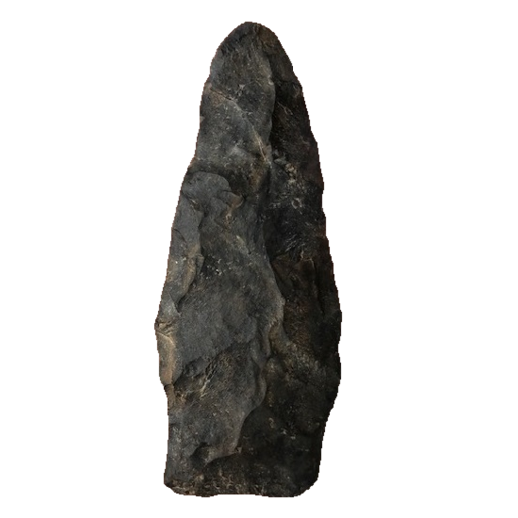
Arrowhead type
Fox Creek Point
Fox Creek2,000 - 1,100 B.P.Early Woodland7 reference photos
Key facts
- Age
- 2,000 - 1,100 B.P.
- Cultural period
- Early Woodland
- Culture
- Fox Creek Culture
- Size
- Medium to Large
- Shape
- Straight Stem to Expanding Stem to Lanceolate
- Material
- Jasper
- Glacial period
- Roman Warm to Vandal Minimum
More from the Woodland period
Description
The medium-stemmed point exhibits a distinctive elliptical profile in cross-section, with the blade displaying a slender, lanceolate form and an excurvate curvature. The rounded shoulders rise at a gentle incline, while the stem's morphology can vary, ranging from a straight alignment to a subtle expansion. A variant of this point features a side-notch configuration, characterized by a stem that expands more noticeably. The basal edge can assume a range of forms, from a straight line to a concave curve. The flaking pattern on this point is random, lacking a discernible order or sequence.
Size
The dimensions of the arrowheads are as follows: they range in overall length from 25 to 89+ mm, with stem lengths varying between 12 and 20 mm. The width of the blade spans from 24 to 40 mm, while the basal width measures between 16 and 28 mm. In terms of thickness, the arrowheads are between 6 and 11 mm.
Distribution
This type is mainly located from New York down to Virginia, Possibly extending into North Carolina with less regularity
Additional information
In the realm of Native American archaeology, a specific type of arrowhead has garnered significant attention due to its distinctive characteristics and varied nomenclature. Initially identified in the New York region by Richie in 1961, these points were first referred to as Steubenville points, drawing parallels with similar finds in the Ohio River valley. The Steubenville designation originated from the work of William J. Mayer-Oakes, who named these points after examples unearthed at the Steubenville Shell Heap site in Brooks County, West Virginia. However, it is essential to note that the Steubenville points are typically associated with the Archaic period, whereas the points in question are more accurately classified as Middle Woodland points.
This distinction prompted Funk to reintroduce these points as Fox Creek points in 1971, providing a more precise classification. Meanwhile, in Maryland, Tomas Mayr described similar points in 1972, coining the term Selby Bay points. Interestingly, both the Fox Creek and Selby Bay designations are still employed in contemporary archaeological discourse to describe these points. The morphology of these points can exhibit a range of forms, including lanceolate, stemmed, and side-notched configurations. A notable aspect of these points is their frequent association with Petalas Blades, highlighting the complex and nuanced nature of Native American lithic technology.
The coexistence of multiple names for these points underscores the complexities of archaeological nomenclature, where regional variations and historical context can influence the classification and naming of artifacts. Despite these variations, the Fox Creek/Selby Bay points remain an important area of study, offering valuable insights into the technological and cultural developments of Native American communities during the Middle Woodland period. By examining the characteristics and distribution of these points, researchers can gain a deeper understanding of the social, economic, and environmental factors that shaped the lives of these ancient cultures.
Identified by
- Named by
- Robert Funk and Thomas Mayr
- Year
- 1971
- Type site
- Comment: Richard Maxson has pointed out that this point was named by Dick Maxson in the 1973 publication Aboriginal Settlement Patterns in the Northeast, by William Richie and Robert Funk page 130.
Similar types
Types that are easy to confuse with the Fox Creek point.
- Holland
- Johnson
Other types in this cluster
- Petalas Blade