
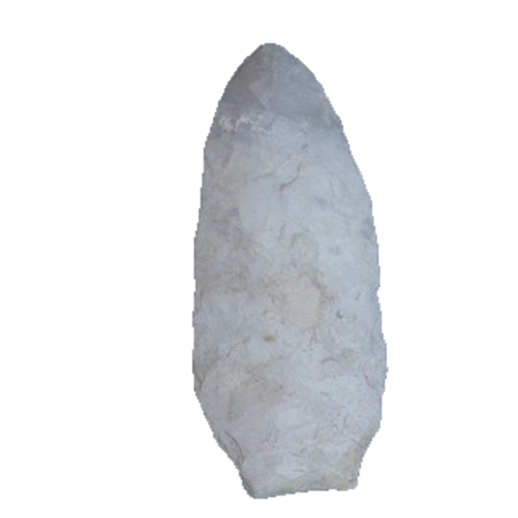
Arrowhead type
Steubenville Point
Steubenville9,000 - 8,000 B.P.Early Archaic8 reference photos
Key facts
- Age
- 9,000 - 8,000 B.P.
- Cultural period
- Early Archaic
- Size
- Medium to Large
- Shape
- Straight Stem to Contracting Stem to Expanding Stem
- Glacial period
- Early Holocene
More from the Archaic period
Description
This stemmed point exhibits a robust morphology, characterized by a medium to large size and a broad, flattened profile. The blade's curvature can range from a straight alignment to a pronounced excurvate shape, while the shoulders are positioned at an acute, upward inclination. The stem's outline may be straight or exhibit a subtle contraction, and the base can display a variety of forms, including concave or bifurcated configurations. A notable feature of this point is the frequent presence of basal grinding and thinning, which suggests a deliberate effort to refine its shape. The flaking pattern on this point is random, lacking a discernible order or sequence, and is superimposed on a substrate that may be composed of various lithic materials.
Size
The dimensions of the arrowheads are as follows: they exhibit a total length ranging from 44 to 88 mm, with the stem portion measuring between 15 and 20 mm in length. The overall width spans 25 to 35 mm, while the stem width varies from 17 to 28 mm. In terms of thickness, the arrowheads measure between 4 and 8 mm.
Distribution
This type is mainly discovered in the northern Ohio River region and extending into western New York.
Mainly found in
Additional information
In the realm of Native American archaeology, a distinct category of arrowheads has been identified, which may be designated as Fox Creek points. Notably, this terminology can be somewhat misleading, as the Fox Creek points typically associated with this name are actually characteristic of the Woodland period and originate from eastern regions. In contrast, the points in question are more accurately attributed to the early Archaic period, highlighting a significant temporal and cultural distinction. This discrepancy underscores the importance of precise classification and contextualization in understanding the complexities of Native American archaeological record.
The early Archaic period, spanning from approximately 8,000 to 1,000 BCE, is marked by the development of distinctive lithic technologies, including the production of arrowheads. These early points, such as the ones referred to as Fox Creek points, exhibit unique morphological characteristics that set them apart from their Woodland period counterparts. A thorough examination of these points reveals a nuanced understanding of the technological and cultural advancements of early Archaic societies, providing valuable insights into the lives and traditions of Native American communities during this period.
The differentiation between these early Archaic points and the Woodland period Fox Creek points is crucial for a comprehensive understanding of the archaeological record. By recognizing and respecting these cultural and temporal boundaries, researchers can reconstruct a more accurate narrative of Native American history, one that acknowledges the diversity and complexity of indigenous cultures across North America. As such, the study of these early Archaic points offers a fascinating window into the lives of ancient societies, inviting further exploration and discovery into the rich and varied heritage of Native American communities.
Identified by
- Named by
- William Mayer-Oakes
- Year
- 1955
Similar types
Types that are easy to confuse with the Steubenville point.