
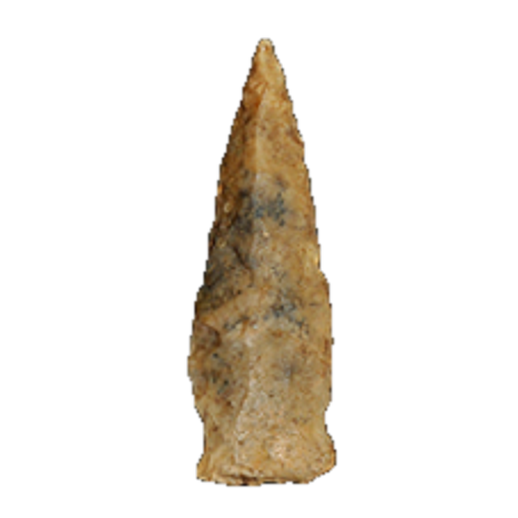
Arrowhead type
Duval Point
Duval1,500 - 1,100 B.P.Late Woodland to Mississippian10 reference photos
Key facts
- Age
- 1,500 - 1,100 B.P.
- Cultural period
- Late Woodland to Mississippian
- Culture
- Weeden Island Culture
- Size
- Small to Medium
- Shape
- Straight Stem
- Material
- Flint
- Glacial period
- Roman Warm to Vandal Minimum
More from the Woodland, Mississippian periods
Description
This triangular point exhibits a stout, crudely fashioned profile, characterized by a small to medium size and an elliptical to diamond-shaped cross-sectional morphology. The blade's curvature is predominantly excurvate, lending it a distinctive spike-like appearance. The shoulders display variability, ranging from a horizontal orientation to an upward inclination. The stem is notable for its expanding shape, with a longitudinal profile that can be either convex or straight. The basal corners of the stem are consistently rounded. The flaking pattern observed on this point is random, lacking a discernible order or organization.
Size
Subtype 1: characterized by a side-notched point with a shallow notch and a straight base, fall within the following ranges: length, 45-51 mm; width, 14-19 mm; and thickness, 6-11 mm, as defined by Bullen.
Subtype 2: distinguished by a short stem with a straight base, exhibits size measurements ranging from 40-65 mm in length, 13-18 mm in width, and 6-9 mm in thickness, according to Bullen's classification.
Subtype 3: recognizable by its expanding stem to side notch point and convex base, with the possibility of a serrated blade, displays a broader range of size measurements: length, 35-70 mm; width, 13-21 mm; and thickness, 7-11 mm, as specified by Bullen.
Distribution
This type is mainly located in the central region of Florida, extending into southern parts of Georgia and southeastern areas of Alabama
Additional information
In the realm of Native American arrowheads, a particular point of interest has been identified as a potential precursor to the Jackson type point. Notably, this point exhibits a similar geographic distribution to the Jackson type, sharing many characteristics in common (Granger and Granger, 2013). A key distinction can be observed in the spike-type points found in Georgia and Florida, as highlighted by Schroder (W18). Specifically, the Bradley Spike is characterized by a stem that can range from straight to contracting, terminating in a pointed base. In contrast, the Duval point features a stem that can be either straight or bulbous, while the Flint River point boasts a rounded stem. The New Market point, on the other hand, is marked by a contracting stem, and the Schild point has a short, straight to slightly expanding stem. Furthermore, the Florida Spike is distinguished by a straight to contracting stem with a straight base.
The classification of these spike-type points has undergone significant discussion, with the term "Woodland Spike" being used to collectively categorize all Woodland period spike-type points. This term was initially employed by Whatley, who sought to group these points into a single category. While Farr attributes the term "Woodland Spike" to Whatley, Schroder credits Jerald Ledbetter with coining the name. This highlights the complexities and nuances involved in the classification and nomenclature of Native American arrowheads, underscoring the importance of careful consideration and collaboration among archaeologists.
The study of these spike-type points offers valuable insights into the cultural and technological practices of Native American communities during the Woodland period. By examining the distinct characteristics of each point, such as stem shape and base morphology, researchers can gain a deeper understanding of the regional and temporal variations that existed among these communities. Furthermore, the evolution of classification terms like "Woodland Spike" reflects the ongoing refinement of archaeological knowledge and the importance of precise terminology in describing these significant cultural artifacts.
Identified by
- Named by
- Ripley P. Bullen
- Year
- 1951
- Type site
- The Terra Ceia Site, Manatee County, Florida
Similar types
Types that are easy to confuse with the Duval point.
- Bradley Spike
- Bradford
- Copena
- Flint River
- Florida Spike
- Jackson
- New Market