
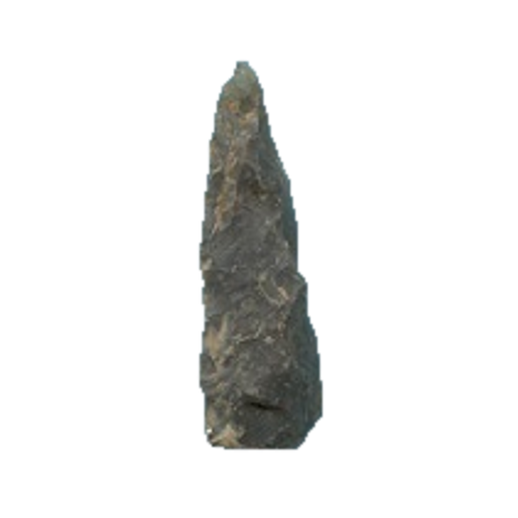
Arrowhead type
Flint River Spike Point
Flint River Spike1,800 - 1,300 B.P.Middle Archaic to Late Woodland3 reference photos
Key facts
- Age
- 1,800 - 1,300 B.P.
- Cultural period
- Middle Archaic to Late Woodland
- Size
- Small to Medium
- Shape
- Contracting Stem to Ovoid
- Material
- Flint
- Glacial period
- Roman Warm to Vandal Minimum
Description
This projectile point exhibits a compact, ovoid silhouette with a thickness that is proportionate to its narrow width. In cross-section, the shape is predominantly elliptical, although a subtle medial ridge may be present, and thicker specimens may approach a circular profile. The blade edge can vary from gently curved to straight, displaying a range of excurvate to rectilinear forms. The shoulders are often subdued, and in some cases, may be nearly imperceptible, contributing to a stem that appears to contract. The basal morphology is characterized by a range of forms, from straight to convex, and may be left unfinished, or exhibit evidence of basal grinding or thinning. The flaking pattern on this point is irregular and non-directional, lacking a discernible pattern or orientation.
Size
The arrowheads exhibit a range of dimensions, with total lengths spanning from 39 to 58 mm, and an average length of 50 mm. In terms of width, they measure between 12 and 21 mm, with a mean width of 16 mm. The thickness of these artifacts varies from 7 to 11 mm.
Distribution
This type is mainly located in northern Alabama, extending into southern Tennessee and northwestern Georgia. The complete range is unclear, but likely spans the entirety of the Tennessee River Valley, mirroring the distribution of the Bradley Spike
Also found, less often, in
Additional information
In the realm of Native American arrowheads, a particular point of interest exhibits similarities to the Bradley Spike point, albeit with a notable distinction - the absence of a stem, a characteristic that sets it apart from its counterpart (Cambron, 1969). This variation highlights the diversity within the spike-type point category, which has been extensively studied by scholars such as Schroder, who has identified distinct differences among points found in Georgia and Florida (W18). Specifically, the Bradley Spike point is distinguished by a stem that can range from straight to contracting, culminating in a pointed base.
A comparative analysis of various spike-type points reveals a range of stem styles, each associated with a specific point type. For instance, the Duval point features a straight to bulbous stem, while the Flint River point has a rounded stem. In contrast, the New Market point boasts a contracting stem, and the Schild point is characterized by a short, straight to slightly expanding stem. Furthermore, the Florida Spike point exhibits a straight to contracting stem with a straight base. The term "Woodland Spike" was initially coined by Whatley as a means of categorizing all Woodland period spike-type points under a single umbrella. Notably, Farr acknowledges Whatley's contribution to the term, whereas Schroder attributes the name to Jerald Ledbetter, underscoring the complexities of nomenclature in the field of archaeology.
The study of these spike-type points offers valuable insights into the cultural and technological practices of Native American communities during the Woodland period. By examining the subtle variations in stem styles and point shapes, researchers can reconstruct the historical context and cultural exchange networks of these ancient societies. As archaeologists continue to refine their understanding of these artifacts, the nuances of their characteristics and classifications will remain essential to unraveling the complexities of Native American cultural heritage.
Identified by
- Named by
- William Webb and David Dejarnette
- Year
- 1948
- Type site
- Flint River Mound Site, Madison County, Alabama
Similar types
Types that are easy to confuse with the Flint River Spike point.