
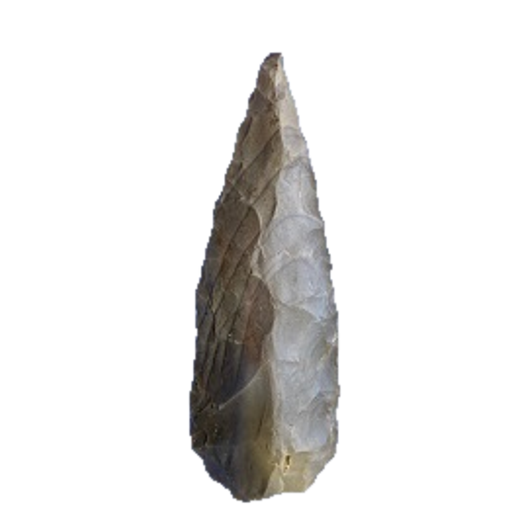
Arrowhead type
Florida Spike Point
Florida Spike1,800 - 1,300 B.P.Middle Archaic to Late Woodland2 reference photos
Key facts
- Age
- 1,800 - 1,300 B.P.
- Cultural period
- Middle Archaic to Late Woodland
- Size
- Small to Medium
- Shape
- Ovoid
- Material
- Flint
- Glacial period
- Roman Warm to Vandal Minimum
Description
This medium to large-sized point exhibits an asymmetrical profile, characterized by a thick, narrow morphology. In cross-section, the point's shape is predominantly elliptical, although some specimens may display a pronounced medial ridge, while thicker examples may approach a rounded form. The blade's curvature varies, spanning from excurvate to straight. The shoulders are often subdued, with one or two weakly defined examples, and the stem appears to contract. The base of the point ranges from straight to convex, and its treatment varies, with some examples left unfinished, while others feature basal grinding or thinning. The point's manufacture is coarse, with percussion flaking predominating, accompanied by minimal pressure flaking, resulting in a random, uneven flaking pattern.
Size
The dimensions of the arrowheads are as follows: they range in overall length from 40 to 85 mm, with widths spanning 15 to 30 mm, and thicknesses measuring between 10 to 15 mm.
Distribution
This specimen has been documented within Florida.
Also found, less often, in
Additional information
In the realm of Native American arrowheads, a specific point type has garnered significant attention from archaeologists, particularly in the southeastern United States. This point bears a striking resemblance to the Flint River Spike, as described by Cambron, and the Woodland Spike, a term coined by Whatley and later referenced by Farr in 2006. A closer examination of the characteristics of these spike-type points reveals distinct variations across different regions. For instance, the Bradley Spike, found in certain areas, exhibits a stem that can range from straight to contracting, culminating in a pointed base.
A comparative analysis of various point types, as noted by Schroder, highlights the unique features of each. The Duval point is distinguished by its straight to bulbous stem, whereas the Flint River point boasts a rounded stem. In contrast, the New Market point is characterized by a contracting stem, and the Schild point features a short, straight to slightly expanding stem. The Florida Spike, another notable example, displays a stem that can be either straight or contracting, with a straight base. These subtle differences underscore the diversity of spike-type points within the Woodland period, a fact that prompted Whatley to introduce the term "Woodland Spike" as a categorical umbrella for these points. It is worth noting that while Farr acknowledges Whatley's contribution to the term "Woodland Spike," Schroder attributes the name to Jerald Ledbetter, highlighting the complexities of archaeological nomenclature.
The study of these arrowhead points offers valuable insights into the cultural and technological practices of Native American communities during the Woodland period. By examining the variations in stem shape and base morphology, researchers can reconstruct the spatial and temporal distributions of these point types, shedding light on the social and economic networks that existed among prehistoric societies. As archaeologists continue to refine their understanding of these artifacts, the nuances of their characteristics will remain essential for reconstructing the lives and traditions of the people who crafted them, providing a rich tapestry of information about the region's cultural heritage.
Identified by
- Named by
- Ripley P. Bullen
- Year
- 1975
Similar types
Types that are easy to confuse with the Florida Spike point.