
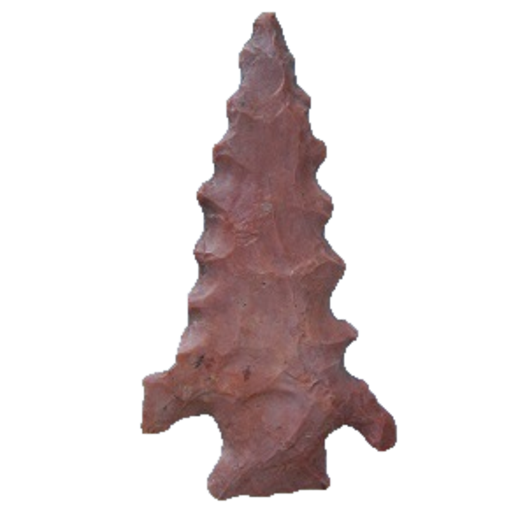
Arrowhead type
Datil Point
DatilDatil Cluster3,600 - 2,300 B.P.Late Archaic2 reference photos
Key facts
- Age
- 3,600 - 2,300 B.P.
- Cultural period
- Late Archaic
- Size
- Small
- Shape
- Expanding Stem to Straight Stem to Corner Notch
- Glacial period
- Neoglacial to Roman Warm
More from the Archaic period
Description
This diminutive, stemmed projectile point exhibits a distinctive elliptical profile in cross-section. Its blade features a pronounced excurvate curvature, accompanied by deep serrations that impart a toothed edge. The shoulder regions are often subdued or entirely absent, resulting in an ovoid silhouette in many instances. The stem morphology is predominantly straight, although some variation is observed, with stems occasionally expanding or contracting slightly. Notably, the basal dimensions of this point can fluctuate significantly, with the base itself typically presenting a straight edge, albeit sometimes with a subtle convex curvature. The flaking pattern observed on this point is characterized by a random, non-directional arrangement of flake scars.
Size
The dimensions of the arrowheads are as follows: they range in overall length from 28 to 75 mm, with stem lengths varying between 9 and 14 mm. The width of the blade spans from 16 to 34 mm, while the stem width and basal width measure between 9 to 20 mm and 9 to 19 mm, respectively. In terms of thickness, the arrowheads are between 4 and 8 mm.
Distribution
This arrowhead is mainly located in the southwestern region. It is predominantly discovered in southern Arizona, southern New Mexico, northern Sonora, and northwestern Chihuahua, although sightings have been documented as far as southeastern Utah and southwestern Colorado. The type has also been identified at the La Playa site in northern Sonora, Mexico
Additional information
In the realm of Native American arrowhead studies, a particular point of interest bears resemblance to the Fresnal point, which derives its name from the Fresnal shelter located in New Mexico. This similarity was first noted by Jones in 1990. However, despite this initial observation, the archaeological community has yet to establish a sizable corpus of recognized Fresnal points, which would be necessary to conduct a comprehensive comparative analysis with the Datil point. As highlighted by Justice in 2002, the lack of a substantial sample size of Fresnal points hinders our ability to discern distinct technological differences between these two point types, leaving a gap in our understanding of their respective characteristics and evolutionary trajectories.
Further examination of the Fresnal point and its potential connections to the Datil point could provide valuable insights into the technological and cultural developments of the Native American groups that crafted these arrowheads. The Fresnal shelter in New Mexico serves as a significant geographical reference point, underscoring the importance of regional context in the study of these artifacts. By continuing to investigate and catalog additional Fresnal points, researchers may uncover new evidence that sheds light on the technological nuances and cultural associations of these enigmatic arrowheads.
The study of Fresnal and Datil points underscores the complexities and challenges inherent in the field of archaeology, where the availability of data and the integrity of the archaeological record can significantly impact our understanding of the past. As scholars, it is essential to approach these topics with a critical and nuanced perspective, recognizing both the potential for new discoveries and the limitations imposed by the current state of knowledge. By doing so, we can work towards a more comprehensive and accurate understanding of Native American arrowhead technology and its cultural significance, ultimately enriching our appreciation for the history and traditions of the indigenous peoples who created these remarkable artifacts.
Identified by
- Year
- 1965
- Type site
- Bat Cave, New Mexico
Similar types
Types that are easy to confuse with the Datil point.
- Cottonwood Leaf
- Fresnal
- Pelona
- San Pedro
- Truxton