
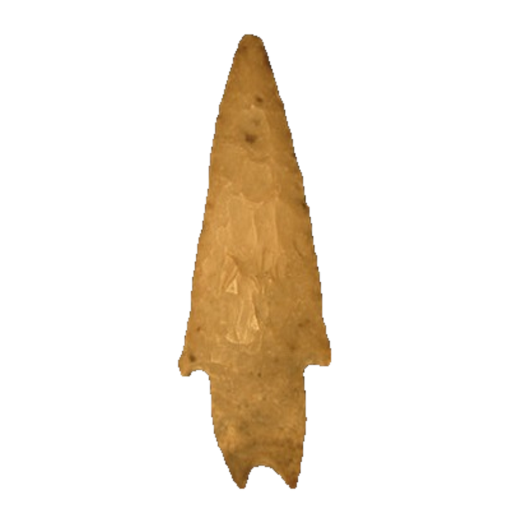
Arrowhead type
Gower Point
Gower8,500 - 7,000 B.P.Late Paleo to Transitional Archaic15 reference photos
Key facts
- Age
- 8,500 - 7,000 B.P.
- Cultural period
- Late Paleo to Transitional Archaic
- Size
- Small to Medium
- Shape
- Straight Stem to Bifurcated
- Glacial period
- Early to Middle Holocene
Description
This triangular point features a stemmed design with an elliptical profile, exhibiting a blade shape that varies from straight to gently curving outward. Notably, the straighter blade forms are often associated with smaller specimens. The shoulders of this point are generally oriented horizontally, although they can be somewhat subdued in certain instances. The stem itself is slender, displaying a range of forms from straight to expanding. Characteristically, one or both basal ears narrow inward, leading to a base that is distinctly concave, sometimes approaching a bifurcated shape. The flaking pattern observed on this point is irregular and non-directional, with many examples showing a somewhat rough or unrefined manufacture.
Size
The arrowhead's dimensions are as follows: its overall length ranges from 40 to 80 mm, while the stem measures between 15 to 30 mm, with an average span of 15 to 20 mm. The blade's width falls within the 25 to 40 mm range, and both the neck and stem widths are between 15 to 25 mm.
Distribution
This type is mainly located in the middle to southern regions of Texas. The occurrence dwindles in the southernmost part of Texas and northern areas of Mexico.
Additional information
More information needed.
Identified by
- Named by
- Harry Shafer
- Year
- 1963
- Type site
- The Youngsport Site, Bell County, Texas
Similar types
Types that are easy to confuse with the Gower point.