
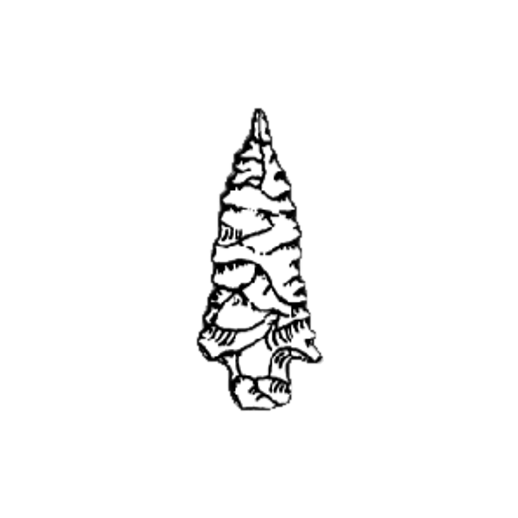
Arrowhead type
Ahumada Point
AhumadaLivermore Stemmed Cluster1,250 - 1,100 B.P.DevelopmentalKey facts
- Age
- 1,250 - 1,100 B.P.
- Cultural period
- Developmental
- Culture
- Cochise, Hohokam, and Mogollon cultures
- Size
- Small
- Shape
- Expanding Stem
- Glacial period
- Vandal Minimum to
More from the Developmental period
Description
This triangular point exhibits a distinctive morphology, characterized by a small to medium size and an elliptical cross-sectional profile. The blade itself is typically slender, with edges that can range from straight to gently curved, often widening at the shoulder area. A notable feature of this point is the consistent presence of serrations along the blade's edge. The shoulders are marked by short, protruding barbs, although these may become less pronounced or even horizontal in instances where the point has undergone re-sharpening, resulting in a reduced blade length. The stem displays variability, ranging from an expanding form to a straight configuration, while the base can be either straight or convex, sometimes appearing unfinished. In some cases, the stem may exhibit a bulbous swelling. The flaking pattern observed on this point is random, lacking a discernible order or orientation.
Size
The dimensions of the arrowheads are characterized by the following measurements: overall length ranges from 20 to 55 mm, with a typical average length of 30 to 35 mm. The stem measures between 6 to 10 mm in length. The blade's width spans 15 to 25 mm, averaging 21 mm. At the shoulders, the stem width is between 7 to 11 mm, while the basal width is recorded as 9 to 16 mm. The thickness of the arrowhead varies from 5 to 9 mm.
Distribution
This type is predominantly located in areas surrounding Villa Ahumada, Mexico, and extends into the Jornada area of northwest Chihuahua, Mexico, and the Trans Pecos area of Texas (mainly Culberson and Hudspeth counties) and into southern New Mexico and southeast Arizona
Mainly found in
Additional information
A recent observation by Moore, published in 2015, suggests a potential connection between the point in question and one previously discussed by Turner and colleagues in their 2011 study. Notably, the latter researchers identified the point as a Van Horn point, a classification that may also be applicable to the former. This possible correlation highlights the importance of ongoing research and collaboration in the field of archaeology, as it allows for a more nuanced understanding of the cultural and historical contexts surrounding these artifacts. By examining the similarities and differences between these points, researchers can gain valuable insights into the technological, social, and economic developments of the cultures that created them.
The Van Horn point, as identified by Turner et al. in 2011, is a significant find, and its potential connection to the point noted by Moore in 2015 warrants further investigation. A deeper analysis of the point's characteristics, including its morphology, material composition, and distribution, may provide additional clues about its origins and cultural associations. Furthermore, this research can contribute to a broader understanding of the regional and temporal variations in point styles, shedding light on the complex and dynamic nature of Native American cultures.
The study of arrowheads, such as the Van Horn point, is a crucial aspect of archaeology, as these artifacts offer a unique window into the lives and traditions of past societies. By carefully examining and interpreting these points, researchers can reconstruct the technological, social, and cultural practices of Native American communities, ultimately enriching our understanding of their history and heritage. As new discoveries are made and existing knowledge is refined, the field of archaeology continues to evolve, providing a more comprehensive and nuanced picture of the past.
Identified by
- Named by
- Milton F. Krone and Richard "Scotty" MacNeish
- Year
- 1976
Similar types
Types that are easy to confuse with the Ahumada point.