
Arrowhead type
Afton Point
Afton5,000 - 3,000 B.P.Late Archaic33 reference photos
Key facts
- Age
- 5,000 - 3,000 B.P.
- Cultural period
- Late Archaic
- Size
- Medium to Large
- Shape
- Corner Notch
- Material
- Pottery
- Glacial period
- Middle Holocene
More from the Archaic period
Description
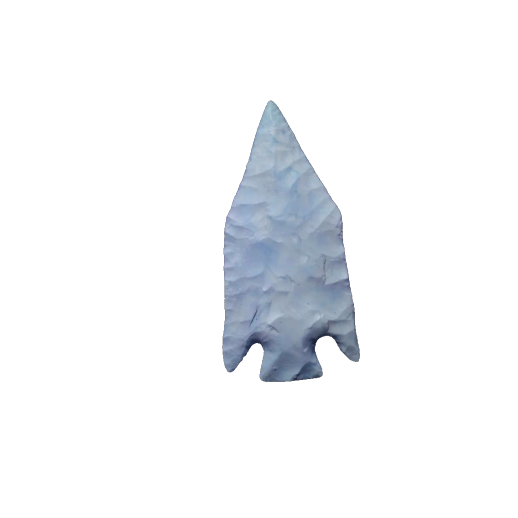
This artifact exhibits a distinctive pentagonal morphology, measuring between 2 to 4.1 inches in length, with a cross-sectional profile that is notably flattened. The blade's angular contours define its pentagonal shape, while the terminus is typically characterized by a corner-notched configuration, although some variants display a stemmed morphology. The shoulders of this point are predominantly barbed, yet may occasionally assume a horizontal orientation, particularly in the stemmed iterations. The stem itself can range from expanding to contracting, with a basal profile that varies from straight to convex. Notably, the craftsmanship evident in this point is of high quality, achieved through the application of broad percussion flaking, supplemented by pressure flaking to refine the blade's edges, resulting in a random, yet deliberate, flaking pattern.
Size
The arrowhead's dimensions are as follows: its overall length ranges from 51 to 102 mm, while the stem measures between 10 to 18 mm in length. The blade itself spans a width of 30 to 40 mm, with the neck width varying from 15 to 25 mm. In terms of thickness, the arrowhead measures between 7 to 11 mm.
Distribution
This type is mainly located in the central to southern Mississippi River basin and extending into the Missouri River basin. It is widespread throughout the Ohio River basin and into the Illinois River basin (also known as Pentagonal Knife). It is commonly found throughout the Tennessee River basin. Its presence tapers off into the Red River basin and eastern Texas
Additional information
In the archaeological record of the Columbia Plateau, a distinctive type of knife point has been identified, known as the Plateau Pentagonal Knife. This particular point style is also referred to as the Pentagonal Knife or simply "Pentagonals" in the Ohio region and its surrounding areas. Notably, some researchers have suggested that the Pentagonal Knives found in the Ohio River valley and those associated with the Afton type may represent two distinct categories. However, Robert Bell's 1958 study argued that these points share identical characteristics and date back to the same pre-pottery period, leading him to conclude that they belong to the same type.
Bell's research also highlighted a variant of the Pentagonal Knife, characterized by a straight stem and shoulders that exhibit either a horizontal or upward-sloping orientation. This variant is significant not only for its unique morphology but also for its antiquity, as it is considered an older point style compared to similar types, such as the Jacks Reef Pentagonal point. Furthermore, the Plateau Pentagonal Knife is distinguished by its larger size relative to other similar points, underscoring its importance in the archaeological record of the region.
The Plateau Pentagonal Knife's presence in both the Columbia Plateau and the Ohio River valley regions underscores the complexity and diversity of pre-pottery period cultures in North America. The point's distinctive pentagonal shape and varied stem and shoulder configurations make it a valuable tool for archaeologists seeking to reconstruct the technological, social, and cultural practices of ancient societies. As such, continued study of the Plateau Pentagonal Knife and its variants is essential for deepening our understanding of the rich and nuanced history of Native American cultures in these regions.
Identified by
- Named by
- R. H. Harper and Robert E. Bell
- Year
- 1901
- Type site
- The Afton Springs Site, Ottawa County, Oklahoma
Similar types
Types that are easy to confuse with the Afton point.