
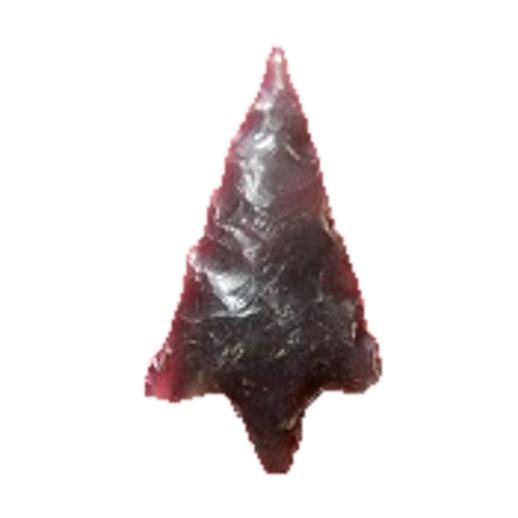
Arrowhead type
Yana Point
YanaGunther Cluster1,500 - 400 B.P.Developmental to Historic10 reference photos
Key facts
- Age
- 1,500 - 400 B.P.
- Cultural period
- Developmental to Historic
- Culture
- Yana Culture
- Size
- Small
- Shape
- Contracting Stem to Basal Notch
- Glacial period
- Vandal Minimum to Little Ice Age
More from the Developmental, Historic periods
Description
This artifact exhibits a distinctive triangular morphology, characterized by a medium to small size and a stem that tapers inward, forming a contracted profile. In cross-section, the blade displays an elliptical shape. The lateral edges of the blade are predominantly excurvate, although smaller specimens may exhibit a straighter profile. The shoulders are positioned at an acute, upward-oriented angle and are smoothly rounded. The stem itself is notably short and broad, with a pronounced contraction. The basal margin varies in shape, ranging from a convex curve to a straight edge. The flaking pattern observed on this point is random, lacking a discernible order or orientation.
Size
The dimensions of the arrowhead are as follows: overall length ranges from 18 to 34 mm, while the stem measures between 4 to 9 mm in length. The blade itself spans a width of 14 to 22 mm, and at the shoulders, the stem width is recorded between 4 to 8 mm.
Distribution
This type is mainly located in the upper Sierra Nevada mountain ranges of California, Nevada, and Oregon.
Mainly found in
Also found, less often, in
Additional information
The study of projectile points has shed significant light on the cultural affiliations of Ishi, a man widely regarded as the last member of the Yana, or Yahi, people, based on his linguistic background. Notably, research conducted by MS Shackley in 2000 revealed that the arrowheads crafted by Ishi were, in fact, characteristic of the Wintu people, rather than the Yana. This discovery has led many scholars to suggest that Ishi may have had Wintu ancestry, potentially to the extent of being half Wintu. This finding underscores the complexities of cultural identity and the need for a nuanced understanding of the intersections between language, material culture, and ethnicity.
Excavations at Kingsley Cave in 1955 and Payne Cave in 1957, conducted by Baumhoff, have provided valuable insights into the projectile point styles associated with the Yana territory. The archaeological record from these sites has yielded small, Desert-type points, which Baumhoff termed Redding Complex points. These points are commonly linked to the Wintu culture, which was prevalent in the same region. Additionally, Baumhoff identified contracting stem points, which he referred to as Shasta Complex points. However, subsequent research has led to the reclassification of these points as part of the Gunther Barbed complex. The presence of these distinct point styles in Yana territory highlights the dynamic nature of cultural exchange and the importance of considering the material record in reconstructions of Native American cultural histories.
The analysis of projectile points from these sites has significant implications for our understanding of the cultural landscape of the region. The co-occurrence of Redding Complex and Gunther Barbed complex points in Yana territory suggests a complex pattern of cultural interaction and exchange, which may have involved the Wintu and other neighboring groups. Furthermore, the study of these points underscores the importance of considering the material culture of Native American groups in conjunction with linguistic and ethnographic data, in order to gain a more comprehensive understanding of their cultural identities and historical experiences. By examining the archaeological record in tandem with other lines of evidence, researchers can work towards a more nuanced and accurate reconstruction of the rich and diverse cultural heritage of Native American communities.
Identified by
- Named by
- Martin A. Baumhoff
- Year
- 1957
- Type site
- Kingsley Cave and Payne Cave
Similar types
Types that are easy to confuse with the Yana point.