
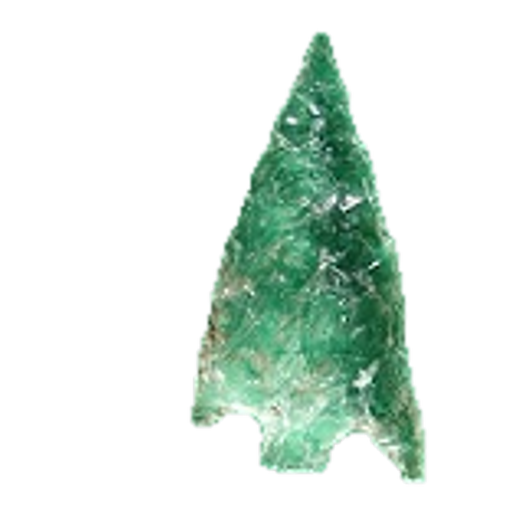
Arrowhead type
Gunther Point
GuntherGunther Cluster1,000 - 200 B.P.Developmental to Classic19 reference photos
Key facts
- Age
- 1,000 - 200 B.P.
- Cultural period
- Developmental to Classic
- Size
- Small
- Shape
- Basal Notch to Contracting Stem to Triangle to Lanceolate
- Glacial period
- Medieval Warm to Little
More from the Developmental, Preclassic and Classic periods
Description
This triangular point exhibits a slender profile, with a medium-sized stem that tapers towards the base, showcasing a flattened cross-sectional morphology. The blade itself is characterized by a broad, sweeping shape that can range from gently outward-curving (excurvate) to inwardly curved (incurvate), often featuring serrations along its edge. The shoulders of the point are distinguished by elongated barbs that typically extend downwards, sometimes surpassing the base, and can display either symmetrical or asymmetrical arrangements. The stem's morphology varies, ranging from straight to contracting, with a base that can be either straight-edged or tapering to a point. Notably, the craftsmanship of this point is often of high quality, as evidenced by its meticulous flaking pattern, which appears to be random in nature.
Size
The dimensions of the arrowheads are as follows: they range in overall length from 27 to 39 mm, with stem lengths varying between 3 to 6 mm. The width of the blade spans 14 to 26 mm, while the stem width at the shoulders measures between 4 to 6 mm. In terms of thickness, these arrowheads are between 3 to 5 mm.
Distribution
This type is mainly discovered in northern California and extends upwards into the Columbia River Valley. It is also located westwards across the Great Basin, albeit with lesser regularity.
Mainly found in
Additional information
In northern California's Shasta Reservoir region, a distinct type of arrowhead, known as the Shasta Complex points, was first identified by Baumhoff. These points are often linked to the Yana culture, which flourished in the area. Notably, variations of this type were also discovered at the Sutter Site in Sutter County, California, prompting Dougherty (1990) to coin the term "Sutter Contracting Stem" to describe these specific examples. Furthermore, similar points found in the Rogue River Valley of southeastern Oregon have been referred to as "Rough River" points.
The Shasta Complex points exhibit characteristics that overlap with those of the Rosegate cluster, suggesting a potential connection between the two. The timeline for the Shasta Complex points is believed to have begun during the same period as the Rosegate type points and continued into the time frame associated with the Desert Cluster. However, metric attributes, such as the contracting stem and exaggerated barbed features, distinguish the Shasta Complex points from those in the Rosegate cluster. Despite these differences, Hughes (1986) suggests that the Shasta Complex points may be part of the Rosegate cluster based on their temporal placement.
The identification of Shasta Complex points can be challenging, particularly in Mendocino County, where they bear a strong resemblance to Rattlesnake points. In fact, Justice (2002) has proposed the term "Gunthersnake" to describe these points. Cassinelli (1996) has further classified the Shasta Complex points into three subcategories: Abrupt Shoulder, Round Shoulder, and Short Barb. These classifications highlight the diversity within the Shasta Complex points and demonstrate the complexity of Native American arrowhead typology. By examining the characteristics and variations of these points, researchers can gain a deeper understanding of the cultural and technological developments of the region's indigenous populations.
Identified by
- Named by
- Adan E. Treganza
- Year
- 1958
- Type site
- Gunther Island Site (Ca Hum 67), Humboldt County, California
Similar types
Types that are easy to confuse with the Gunther point.
- Alkali
- Calapooya
- Columbia Plateau
- Eastgate
- Parowan
- Point Sal Barbed
- Rabbit Island
- Rattlesnake
- Rose Springs
- Wallula
Other types in the Gunther Cluster
- Gunther Triangular
- Sutter Contracting Stem