
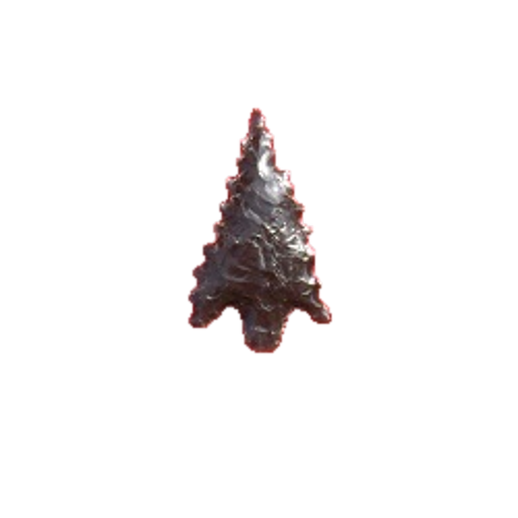
Arrowhead type
Calapooya Point
Calapooya1,000 - 150 B.P.Developmental to Historic14 reference photos
Key facts
- Age
- 1,000 - 150 B.P.
- Cultural period
- Developmental to Historic
- Culture
- Kalapuya Culture
- Size
- Small
- Shape
- Straight Stem to Contracting Stem to Basal Notch
- Glacial period
- Medieval Warm to Little Ice Age
More from the Developmental, Historic periods
Description
This triangular point features a slender, stemmed profile with a cross-sectional shape that transitions from flat to a thin, elliptical form. The blade's curvature is predominantly outward, exhibiting a pronounced excurvate shape, and is adorned with deep serrations that follow the edge. The shoulders of the point are characterized by barbed formations, which may terminate in either sharp, pointed tips or squared-off ends. The stem itself can vary in orientation, ranging from a straight alignment to a more contracted form, and is accompanied by a base that can be either straight or convexly curved. The flaking pattern observed on this point is random, lacking a discernible, organized arrangement.
Size
The dimensions of the arrowheads are as follows: they range in overall length from 10 to 35 mm, with stem lengths varying between 3 to 6 mm. The width of the blade spans from 9 to 16 mm, while the stem width measures between 3 to 6 mm.
Distribution
These artifacts are predominantly discovered in Oregon's Willamette Valley region. They can be located from the Cascade Range to the Oregon coastline and the Columbia River to the Calapooya Mountains, which was the core territory of the Calapooya tribe
Mainly found in
Additional information
In the realm of Native American arrowheads, a distinctive variant has been identified and colloquially referred to as "Fern Leaf" among collectors. Characterized by its notable morphology, this type exhibits deeply serrated or barbed edges, which likely served to enhance hunting efficacy by inflicting more severe wounds. Additionally, the Fern Leaf arrowhead features a short, contracting stem, a trait that distinguishes it from other types of projectile points. This unique combination of characteristics underscores the resourcefulness and adaptability of the indigenous cultures that crafted these artifacts, highlighting their ingenuity in designing hunting tools tailored to their specific needs and environments.
Identified by
- Named by
- Smithsonian publications
Similar types
Types that are easy to confuse with the Calapooya point.
- Columbia Plateau
- Gunther
- Rabbit Island
- Wallula Gap