
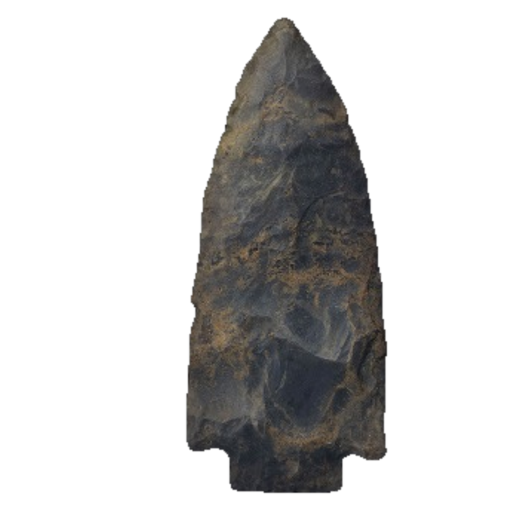
Arrowhead type
White Springs Point
White SpringsWhite Springs Cluster7,000 - 6,000 B.P.Middle Archaic12 reference photos
Key facts
- Age
- 7,000 - 6,000 B.P.
- Cultural period
- Middle Archaic
- Size
- Medium
- Shape
- Straight Stem to Expanding Stem to Contracting Stem
- Material
- Quartz
- Glacial period
- Middle Holocene
More from the Archaic period
Description
This triangular stemmed point exhibits a slender profile with a cross-sectional shape that is typically flattened, although occasionally it may assume an elliptical form. The blade's curvature is predominantly excurvate, yet it can vary to a straight alignment, and in some instances, particularly on re-sharpened specimens, an incurvate shape may emerge. The notching pattern is characterized by the removal of triangular platform corners, resulting in shallow notches with shoulders that are either horizontal or slope downward slightly, devoid of barbing. The stem, which is short and broad, can range from a straight to a slightly expanding configuration. The base of the point is generally straight, although it may exhibit a slight concavity. The flaking pattern on these points is random, and in some cases, evidence of basal grinding and thinning can be observed, indicating deliberate edge refinement.
Size
The dimensions of the arrowheads are as follows: - Overall length ranges from 25 to 66 mm, with a typical average length of 40 to 50 mm. - The stem measures between 3 and 12 mm in length, averaging 6 to 8 mm. - Blade width varies from 18 to 36 mm, with an average width of 19 to 32 mm. - At the shoulders, the stem width ranges from 12 to 25 mm, averaging 17 to 21 mm. - The basal width is between 11 and 25 mm, with an average of 18 to 20 mm. - The thickness of the arrowheads measures between 3 and 10 mm.
Distribution
This type is mainly located in the Tennessee River Valley. It also appears in the southern Ohio River Valley, albeit less commonly.
Also found, less often, in
Additional information
In their 1964 study, Cambron and Hulse proposed a cultural connection between a specific arrowhead point and two other notable types: the Benton Stemmed and Buzzard Roost Creek points. The Benton Stemmed point is believed to have been utilized subsequent to the point in question, as well as the Buzzard Roost Creek point, suggesting a chronological sequence. Furthermore, this point is thought to have evolved into the Sykes point, demonstrating a clear technological lineage. Notably, the craftsmanship exhibited by this point is of exceptionally high quality, surpassing that of its successors, as observed by Justice in 1987.
A comparative analysis with the Sykes point reveals distinct characteristics, particularly in terms of stem morphology. The White Springs point, which bears similarities to the Sykes point, typically features a smaller stem that is thinned at the base, whereas the Sykes point often has a slightly longer stem with less frequent basal thinning, as documented by MaGahey in 2000. This subtle yet significant difference highlights the refinement and attention to detail that characterized the manufacture of these early arrowhead points.
The evolution of these point types underscores the dynamic nature of Native American technological development, with each successive type building upon the innovations of its predecessors. The high-quality workmanship evident in this point, as well as its distinctive morphological features, provide valuable insights into the cultural and technological practices of the societies that created them. By examining these artifacts in detail, researchers can reconstruct the complex histories of Native American communities, shedding light on their technological, social, and cultural achievements.
Identified by
- Named by
- David Hulse
- Year
- 1961
- Type site
- Hulse Site 17, Limestone County, Tennessee
Similar types
Types that are easy to confuse with the White Springs point.
- Benton
- Buzzard Roost Creek
- Sykes