
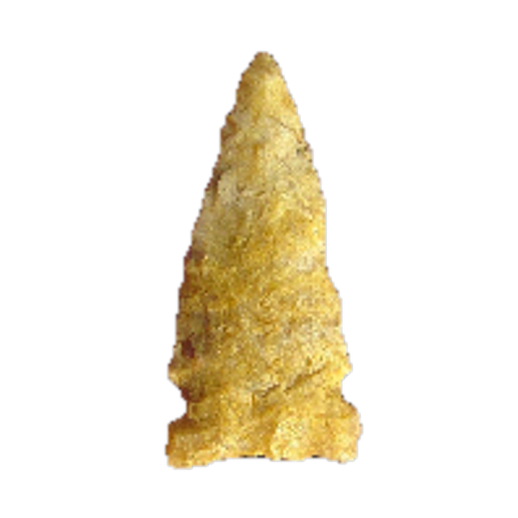
Arrowhead type
Timber Ridge Point
Timber RidgePlains Small Side Notch Cluster1,800 - 900 B.P.Late Woodland3 reference photos
Key facts
- Age
- 1,800 - 900 B.P.
- Cultural period
- Late Woodland
- Culture
- Avonlea Culture
- Size
- Small to Medium
- Shape
- Side Notch
- Glacial period
- Roman to Medieval Warm
More from the Woodland period
Description
This projectile point features a slender profile, measuring between small to medium in size, with a cross-sectional shape that transitions from elliptical to flattened. The blade's curvature can range from straight to distinctly excurvate, while the shoulders exhibit a range of orientations, from horizontal to angled upward. The stem's morphology varies, being either expanding or fully expanded. The base of the point displays notable variability, ranging from a concave shape to a bifurcated form, and is distinguished by sharper basal ears compared to other point types. The surface of the point showcases refined pressure flaking, characterized by a random, non-patterned arrangement of flake scars.
Size
The dimensions of the arrowheads are as follows: overall length ranges from 12 mm to 42 mm, while the blade width spans from 9 mm to 18 mm, and the thickness measures between 2 mm and 4 mm.
Distribution
This type is mainly discovered in Saskatchewan and Alberta, Canada, and extends into Montana (red). It also appears with decreased regularity in northern Wyoming, northern South Dakota, northwestern Iowa, and western Minnesota (yellow)
Mainly found in
Also found, less often, in
Additional information
The Avonlea point represents a significant milestone in the evolution of Native American arrowhead design, particularly within the Prairie Side Notch tradition. Archaeological research suggests that this type emerged from the earlier Pelican Lake type, marking an important developmental stage in the history of projectile point technology. Notably, the Avonlea point is considered the earliest manifestation of the Prairie Side Notch type, laying the groundwork for subsequent designs.
As documented by Kehoe in 1966, the Avonlea point gave rise to the Swift Current type, which in turn became synonymous with the Prairie Side Notch category. This chronological progression underscores the dynamic nature of arrowhead design, with each type building upon the innovations of its predecessors. The Avonlea point's role in this sequence highlights the ingenuity and adaptability of Native American craftsmen, who continually refined their techniques to create more effective hunting tools.
Kehoe's 1966 study provides invaluable insights into the characteristics of Avonlea points, offering a detailed illustration of their distinctive features. By examining these points within the context of their evolutionary trajectory, researchers can gain a deeper understanding of the cultural and technological exchanges that shaped the development of projectile point technology across the region. The Avonlea point's significance extends beyond its own design, serving as a crucial link in the broader narrative of Native American archaeological history.
Identified by
- Named by
- Thomas Kehoe
- Year
- 1961
- Type site
- Avonlea Site, south central Saskatchewan, Canada / Gull Lake Bison Kill Site Saskatchewan, Canada
Similar types
Types that are easy to confuse with the Timber Ridge point.
Other types in the Plains Small Side Notch Cluster
- Avonlea Carmichael
- Avonlea Timber Ridge
- Plains Side Notch
- Prairie Side Notch