
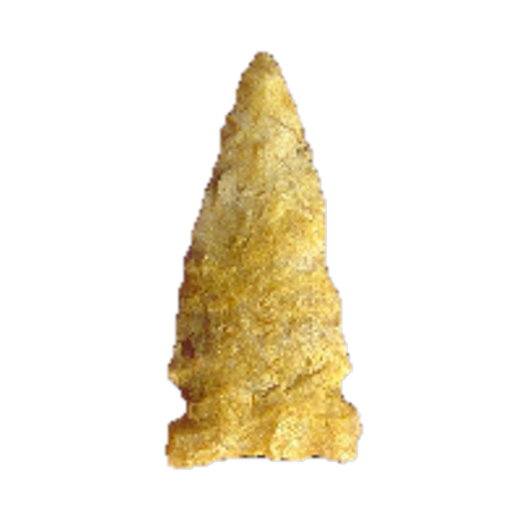
Arrowhead type
Avonlea Timber Ridge Point
Avonlea Timber RidgePlains Small Side Notch Cluster1,800 - 900 B.P.Late Woodland to Developmental2 reference photos
Key facts
- Age
- 1,800 - 900 B.P.
- Cultural period
- Late Woodland to Developmental
- Culture
- Avonlea Culture
- Size
- Small to Medium
- Shape
- Side Notch to Bifurcated
- Material
- Flint
- Glacial period
- Roman to Medieval Warm
More from the Woodland, Developmental periods
Description
This projectile point features a slender profile, measuring between small to medium in size, with a cross-sectional shape that transitions from elliptical to flattened. The blade's curvature can range from straight to distinctly excurvate, while the shoulders exhibit a range of orientations, from horizontal to angled upward. The stem's morphology varies, being either expanding or fully expanded. The base of the point displays notable variability, ranging from a concave shape to a bifurcated form, and is distinguished by sharper basal ears compared to other point types. The surface of the point showcases refined pressure flaking, characterized by a random, non-patterned arrangement of flake scars.
Size
The arrowheads exhibit a range of dimensions, with overall lengths spanning 12 to 42 mm, blade widths varying from 9 to 18 mm, and thicknesses measuring between 2 to 4 mm.
Distribution
This style is mainly discovered in Saskatchewan and Alberta, Canada, and extends into Montana (red). They appear less often in northern Wyoming, northern South Dakota, northwestern Iowa, and western Minnesota (yellow)
Mainly found in
Additional information
The Avonlea point type is considered to be a developmental precursor to the Prairie Side Notch category, with its origins tracing back to the Pelican Lake type. Notably, Avonlea points represent the earliest manifestation of the Prairie Side Notch type, marking the initial stage in this evolutionary sequence. According to the research conducted by Kehoe in 1966, the Avonlea type eventually gave rise to the Swift Current type, which subsequently became synonymous with the Prairie Side Notch classification. This progression highlights the dynamic nature of archaeological typologies, where point types can evolve and transform over time, reflecting the adaptability and innovation of ancient cultures. By examining the characteristics and developmental trajectory of Avonlea points, researchers can gain valuable insights into the technological, social, and environmental factors that shaped the lives of Native American communities on the Great Plains.
Identified by
- Named by
- Thomas Kehoe
- Year
- 1961
- Type site
- Avonlea Site, south central Saskatchewan, Canada / Gull Lake Bison Kill Site Saskatchewan, Canada
Similar types
Types that are easy to confuse with the Avonlea Timber Ridge point.
Other types in the Plains Small Side Notch Cluster
- Avonlea Carmichael
- Plains Side Notch
- Prairie Side Notch