
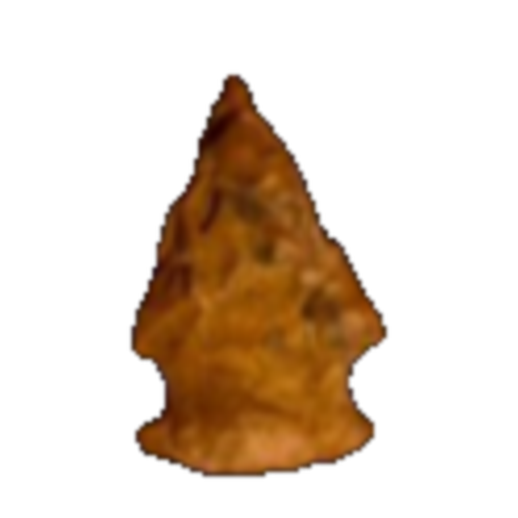
Arrowhead type
Bratton Point
Bratton3,000 - 1,300 B.P.Woodland2 reference photos
Key facts
- Age
- 3,000 - 1,300 B.P.
- Cultural period
- Woodland
- Culture
- Pelican Lake Culture / Bratton Phase
- Size
- Small to Medium
- Shape
- Side Notch
- Glacial period
- Neoglacial to Roman Warm
More from the Woodland period
Description
This triangular point exhibits a distinctive morphology, characterized by a broad, medium-sized form with a corner to side notched configuration. The cross-sectional profile is notably flattened, transitioning to an elliptical shape. The blade's curvature varies from excurvate to occasionally straight, with its maximum width typically situated just above the notches. The notches themselves are shallow and parallel, forming either a U or V shape, and may originate from either the side or corner of the preform. This configuration gives rise to a pronounced neck and shoulders, which are commonly oriented horizontally but can also exhibit a barbed morphology. The stem is short and expands outward, featuring rounded basal corners or ears. The base of the point is convex, with a curvature measuring between 1 mm and 7 mm, and displays evidence of basal thinning and grinding. The manufacturing process involved random percussion flaking, supplemented by pressure flaking to refine and retouch the blade, resulting in a random flaking pattern.
Size
Small to Medium
Distribution
These artifacts are believed to be Pelican Lake style projectiles that evolved into Besant style projectiles mainly discovered in Alberta and Saskatchewan and extending into Montana and North Dakota
Additional information
The archaeological record suggests that this particular point exhibits characteristics that are reminiscent of the Pelican Lake type, while also displaying traits that are indicative of a transitional phase towards the Besant type. As noted by Kevinsen in 2013, this phenomenon is a notable aspect of the point's morphology, highlighting the complex and dynamic nature of lithic technological development. The Pelican Lake type, characterized by its distinctive morphology, is thought to have preceded the Besant type, which emerged as a distinct entity with its own set of diagnostic features. The presence of transitional forms, such as this point, provides valuable insights into the evolutionary processes that shaped the technological and cultural practices of the societies that created them.
The observation that this point is transitioning from a Pelican Lake to a Besant type is significant, as it underscores the idea that lithic technological development is a gradual and continuous process. The fact that Kevinsen's 2013 study identified this point as a transitional form highlights the importance of careful analysis and classification in understanding the complexities of archaeological sequences. By examining the morphological characteristics of this point and situating it within the broader context of Pelican Lake and Besant type points, researchers can gain a deeper understanding of the cultural and technological dynamics that shaped the lives of the people who created these artifacts.
The study of transitional forms like this point offers a unique window into the processes of cultural and technological change, allowing archaeologists to reconstruct the trajectories of technological development and cultural exchange that occurred in the past. As such, this point is not only an important artifact in its own right but also a key component in the larger narrative of human cultural and technological evolution, providing valuable insights into the complex and multifaceted nature of human societies in the past.
Identified by
- Named by
- Ian Dyck and Richard E. Morlan
- Year
- 1995
- Type site
- Sjovold site, Albert, Canada
Similar types
Types that are easy to confuse with the Bratton point.
- Avonlea Timber Ridge
- Besant
- Outlook
- Stott