
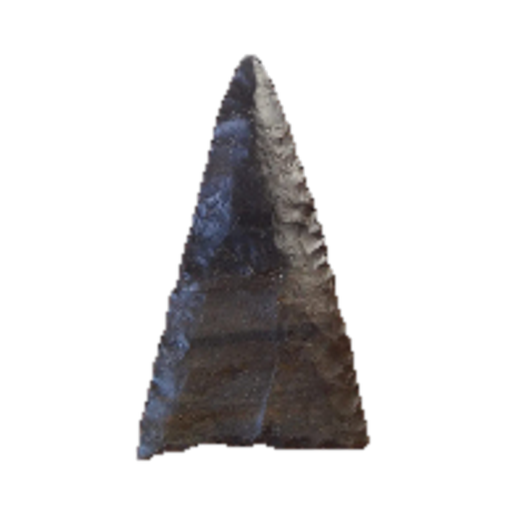
Arrowhead type
Shenks Point
ShenksLate Woodland Triangle Cluster to Early Mississippian Triangle Cluster700 - 400 B.P.Late Woodland4 reference photos
Key facts
- Age
- 700 - 400 B.P.
- Cultural period
- Late Woodland
- Culture
- Shenks Ferry Culture
- Size
- Small to Medium
- Shape
- Triangle
- Material
- Jasper
- Glacial period
- Medieval Warm to Little Ice Age
More from the Woodland period
Description
This triangular point exhibits a slender profile, measuring between 0.5 to 0.75 inches in thickness, with a distinctive cross-sectional morphology characterized by a median ridge. The blade edge is predominantly straight, although subtle variations may introduce a slight incurvate curvature. The overall shape of the point conforms to an isosceles triangular configuration, where the width is approximately half the height. Notable features of the base include a concave outline, often accompanied by basal thinning, which serves to sharpen the basal corners. The flaking pattern appears to be randomly oriented, yet it belies a high degree of craftsmanship, suggesting a skilled manufacturer.
Size
The arrowheads exhibit a range of dimensions, with lengths spanning 18 to 40 mm, widths varying from 14 to 25 mm, and thicknesses measuring between 3 to 6 mm.
Distribution
These artifacts are mainly discovered in Lancaster, York, and Lebanon counties within Pennsylvania. They are predominantly located on the riverbanks of the lower Susquehanna and its affiliated streams.
Mainly found in
Additional information
The concurrent existence of the Shenks Ferry culture and the Susquehannock Culture, coupled with their overlapping geographical territories, presents a challenge in differentiating the triangular arrowhead points utilized by these two distinct cultural groups. Notably, the temporal coincidence of these cultures, which spanned the same time period, has led to a complex archaeological landscape. A key characteristic that can aid in distinguishing between the triangular points employed by the Susquehannock culture and those of the Shenks Ferry culture lies in their morphometric attributes. Specifically, Shenks Ferry points tend to exhibit a slightly narrower profile compared to the triangular points associated with the Susquehannock culture. This subtle yet significant difference underscores the importance of meticulous analysis and measurement in the identification and classification of these archaeological artifacts.
The overlapping territories of the Shenks Ferry and Susquehannock cultures have resulted in a complex distribution of material culture, including triangular arrowhead points, which can be found in various locations across their shared geographical range. As a result, archaeologists must rely on a combination of contextual information, stylistic analysis, and metric data to accurately attribute these points to their respective cultural contexts. The narrower profile of Shenks Ferry points serves as a valuable diagnostic criterion, enabling researchers to discern between the arrowhead points used by these two cultures.
The distinction between Shenks Ferry and Susquehannock triangular points highlights the diversity and complexity of Native American material culture during this time period. The coexistence of these cultures, marked by both shared and distinct characteristics, offers a fascinating glimpse into the social, economic, and technological dynamics of the region. By examining the nuances of their material culture, including the subtle differences in arrowhead point morphology, archaeologists can gain a deeper understanding of the cultural interactions, exchange networks, and technological traditions that defined the lives of these ancient communities.
Identified by
- Named by
- Fred W. Kinsey and Jeffery Graybill
- Year
- 1971
- Type site
- Shenks Ferry (36LA9), Lancaster County, Pennsylvania
Similar types
Types that are easy to confuse with the Shenks point.
- Erie Triangle
- Levanna
- Madison
- Susquehannock
- Squibnocket Triangle
- Yadkin